What The Radical Storage Guarantee Actually Covers
The number that binds a Radical Storage booking is not the one in the adverts. The terms cap the guarantee at EUR 3,000 per bag, refuse electronics entirely, and give you one week to claim.
Short answer
The Radical Storage guarantee is worth EUR 3,000 per bag and per claim under the company's own terms, not the larger figure its marketing shows. It is not insurance. Phones, tablets and laptops are prohibited items under clause 7, and a prohibited item voids the whole claim. Claims carry a one-week deadline and a 48-hour police-report deadline.
A traveller deciding what to leave in a stored bag in New York needs one number, and it is not the number Radical Storage's marketing puts in front of them. The company's own terms and conditions cap the guarantee at EUR 3,000 per bag, and up to EUR 3,000 per claim. The marketing pages show a figure several times larger, sometimes in dollars and sometimes in euros on the very same page, and that larger figure appears nowhere in the terms that actually bind a booking. This guide sets out what the guarantee covers, what it refuses, and what a claim requires, using the company's own documents rather than its adverts.
The short version: the guarantee is real but narrow. It is worth EUR 3,000 per bag. It is not insurance, and the company says so in its own terms. Electronics are prohibited items outright, so a laptop or a phone left in a stored bag is not merely under-covered, it voids the entire claim. And if something goes wrong, you have one week to file and 48 hours to produce a police report. For a fuller walk-through of the drop-off process itself, see how a New York bag drop-off works.
What Does The Radical Storage Guarantee Actually Cover?
The guarantee is a company promise to pay up to EUR 3,000 for a lost or damaged bag, capped at EUR 3,000 per claim as well as per bag. It is not insurance: the terms state plainly that the guarantee is not an insurance policy. It covers bags booked and paid for through the platform, held at a partner point, and it depends on you following the booking and claims rules.
The load-bearing document is the terms and conditions page, which reads: "Each Bag is covered with a Radical Storage Guarantee for a value of EUR 3000" and "the Company will pay up to a maximum of EUR3000 per claim". That is the whole of the promise. It is a contractual commitment from the company, enforceable against the company, and it stops at EUR 3,000.
Two structural limits matter as much as the number. First, clause 9.2.2 of the terms states the guarantee is not insurance, which means there is no underwriter behind it and no regulator treating your suitcase as an insured risk. Second, clause 9.2.1 allows Radical Storage to withdraw the guarantee, so the promise exists at the company's discretion rather than as a standing statutory right. Neither of these makes the guarantee worthless, but both change what you should leave in the bag.
The guarantee also sits on top of a booking structure worth understanding. Every New York booking through this site's roster runs at a typical $4.90 per bag per day plus a $1.99 per-bag checkout fee, which is $6.89 all-in for one bag for one day. Radical Storage itself now disclaims its own advertised $2.90 floor price, saying on its New York page that the final amount "depends on the selected partner, booking date and bag category". The guarantee covers the bag, not the fee you paid for the storage.
There is one more thing the terms publish that almost nobody notices: they carry no version information at all. The page that binds your booking publishes no indication of when its text last changed, so a reader cannot tell how current the clauses are. That is worth knowing before you rely on any summary of them, including this one, and it is why this guide quotes the clauses rather than paraphrasing them.
Why The Marketing Figure And The Terms Figure Do Not Match
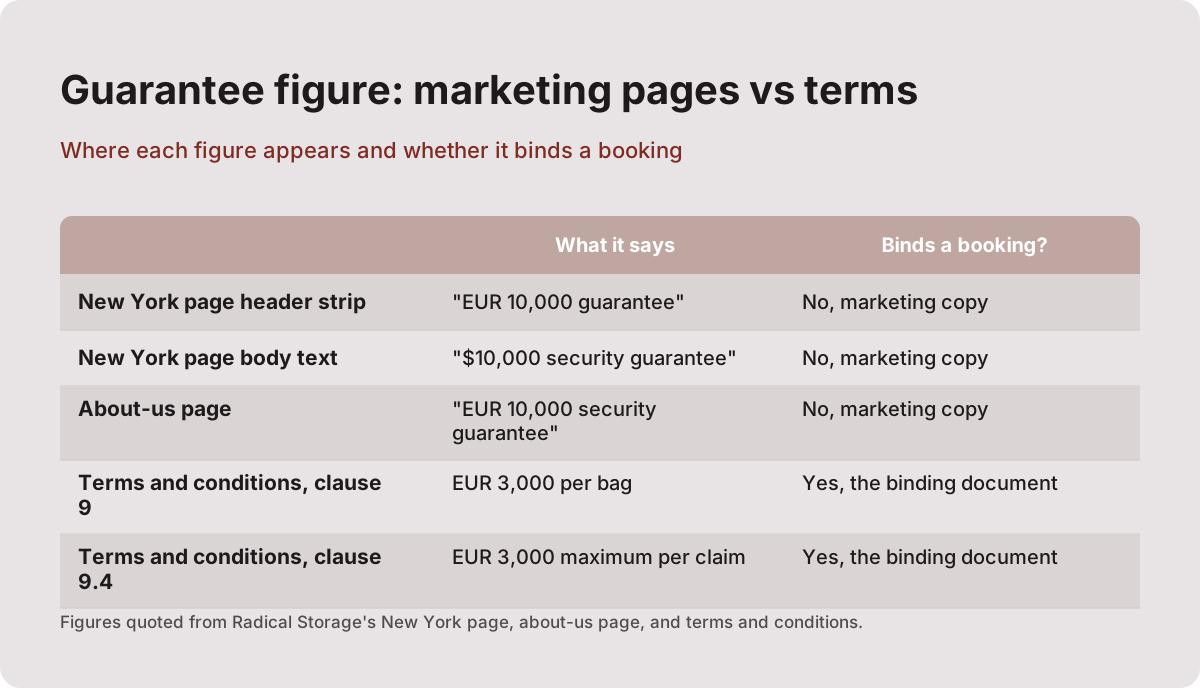
Radical Storage's New York page advertises a guarantee several times larger than its terms allow, and it prints that larger figure inconsistently: the header strip shows it in euros while the body text shows it in dollars on the same page. The terms and conditions, which are the document that governs a booking, contain only the EUR 3,000 figure. When two documents from the same company disagree, the terms are the ones that count.
This is not a subtle discrepancy. The New York page's header reads "EUR 10,000 guarantee" while its body reads "Every booked bag is covered by a $10,000 security guarantee", and the about-us page uses the euro version of the same large figure. The terms and conditions page, re-read in full, contains the strings for EUR 3,000 and nothing larger. A reader who sized their bag's contents to the marketing figure would be planning around a promise the binding document never makes.
| Where the figure appears | What it says | Which document binds a booking |
|---|---|---|
| New York page header strip | "EUR 10,000 guarantee" | No, marketing copy |
| New York page body text | "$10,000 security guarantee" | No, marketing copy |
| About-us page | "EUR 10,000 security guarantee" | No, marketing copy |
| Terms and conditions, clause 9 | EUR 3,000 per bag | Yes, the binding document |
| Terms and conditions, clause 9.4 | EUR 3,000 maximum per claim | Yes, the binding document |
The honest way to read this: the marketing pages are selling, the terms are contracting. If a claim ever went to dispute, the document that governs is the terms and conditions, and its cap is EUR 3,000 per bag and per claim. Treat every larger figure as advertising, not as coverage.

The pattern repeats elsewhere in the company's own publishing. Its New York page header shows "4.8/5 (648K Reviews)" and "16.4K locations", while its about-us page shows "16,500+ Partner Locations" and "4M+ Happy Customers". The two pages do not agree with each other on the company's own size. On Trustpilot, the company is rated "Great" at 4.2 out of 5, a figure attributable to Trustpilot and not to any New York storage point. The lesson for a reader is simple: attribute every number to the page it came from, and when pages conflict, prefer the document that binds.
If you are weighing where to store, the guarantee question and the location question go together. Every one of the 178 Radical Storage points in New York City is a staffed counter at a shop, cafe or hotel, not a locker, so a person is handing their bag to a person. The site's own inventory covers 88 distinct storage points across 8 areas, each counted within 800 metres of its anchor.
What Clause 7 Prohibits: Phones, Laptops And The Claim It Voids
Clause 7 of the terms lists prohibited items, and it includes electronics by name: "Technological material (iPhone, iPad, Tablet, PC, smartphones)" may not be stored at all. A prohibited item in the bag does not just lose its own coverage, it voids the entire claim under clause 9.8.12. Leaving a laptop in a stored bag means the guarantee covers nothing in that bag, not the laptop and not the clothes beside it.
This is the single most expensive trap in the whole document, and it is the reason this guide exists. Most travellers assume a guarantee covers the bag's contents up to the cap. It does not, if the contents include a phone. The prohibition is not a limit on payout for electronics, it is a refusal to accept them, and the consequence of breaking it is total: clause 9.8.12 voids the claim entirely.

The practical rule follows directly: carry your devices with you. A phone fits in a pocket, a laptop fits in a day bag, and neither belongs in a bag you hand across a counter. For a full list of what else should never go into storage, from documents to medication, see what you cannot leave in a stored bag in New York.
It is worth being precise about what the clause does not say. It does not say the partner will search your bag, and it does not describe any inspection process. It simply defines the company's liability, and a company that accepted a claim for a prohibited item would be paying outside its own contract. Plan as though the clause will be applied exactly as written.
How A Claim Actually Works: Deadlines, Police Reports And Payouts
A claim has two deadlines that run simultaneously: one week to file the claim under clause 9.3.5(b), and 48 hours to obtain a police report under clause 9.5. Miss either and the claim fails regardless of its merits. The payout, if the claim succeeds, is capped at EUR 3,000, and the company pays it rather than an insurer.
The 48-hour police-report requirement is the one that catches people out. If a bag goes missing or is damaged, the instinct is to email the platform first and sort out paperwork later. The terms run the other way: the police report is a precondition, and it has to exist within two days of the incident. In New York that means filing with the NYPD, keeping the report number, and having it ready when you contact the company. Everything else covered here is indexed on Luggage Storage Lockers in New York City.
| Claim requirement | What the terms say | Deadline |
|---|---|---|
| File the claim | Clause 9.3.5(b) | One week from the incident |
| Police report | Clause 9.5 | 48 hours from the incident |
| Payout cap | Clauses 9 and 9.4 | EUR 3,000 per bag, EUR 3,000 per claim |
| Prohibited items | Clause 7 and clause 9.8.12 | Any prohibited item voids the claim |
| Published payout timeline | Not stated in the terms | No published service standard |
The one-week claim deadline is equally unforgiving. Seven days from the incident, not from your return home or from the end of your trip. A traveller who discovers a problem on day one of a two-week holiday and files on day ten has no claim under the terms, even for a bag that was genuinely lost.
What the terms do not publish is a payout timeline. There is no published service standard for how long a validated claim takes to pay, so the honest answer to "when would I see the money" is that the company does not say. Budget for the process taking longer than you would like, and keep your booking confirmation, the drop-off details and the police report together from the start.
Is The Guarantee Insurance, And Does It Matter?
No. Clause 9.2.2 of the terms states the guarantee is not an insurance policy, and clause 9.2.1 allows the company to withdraw it. That means there is no underwriter, no policy document and no insurance regulator standing behind the promise, only Radical Storage's own contractual commitment, capped at EUR 3,000 and conditional on the claim rules being followed to the letter.
Why does the distinction matter? Insurance is a regulated product with solvency requirements, complaint routes and, in many jurisdictions, an ombudsman. A contractual guarantee is a promise in a commercial document, enforceable by ordinary legal means and nothing else. If the company declined a claim, your recourse would be the terms themselves, your payment provider, and consumer law, not an insurance regulator.
The withdrawal clause deserves its own sentence. A guarantee the company may withdraw is a guarantee that exists at the company's pleasure. Nothing suggests Radical Storage withdraws it routinely, and the clause is common in commercial terms, but a reader storing high-value contents should know the promise is not a standing statutory right.

The sensible conclusion is not to avoid storage, it is to size the bag to the promise. Clothes, shoes and paperbacks sit comfortably inside a EUR 3,000 cap. A camera body, a work laptop or a jewellery roll does not, and the electronics ban removes the most commonly stored valuables from coverage altogether. For help weighing a location's trust signals against its price, see how to choose a luggage storage spot in New York.
What Travellers Report About The Guarantee And The Booking Flow
Traveller reporting on the platform is mixed and checkable. Trustpilot rates Radical Storage "Great" at 4.2 out of 5, with reviews from September 2026 running both ways: one calls the drop-off "easy, very professional, very safe", while a detailed complaint says the company refuses to share even an approximate storage address until after payment. Neither review concerns a New York point specifically, and neither is a statement about the guarantee's payout record.
The address-after-payment complaint is the most useful piece of traveller reporting for a New York reader, because it sets a real expectation: when you book, you are choosing an area and a price, and the exact street address arrives with the confirmation. A traveller who expects to scout the shop on Street View before paying will be disappointed. Knowing this in advance turns a surprise into a plan.
On the guarantee itself, no first-hand account of a New York claim surfaced in this site's research: no dated payout story, no refused-claim narrative with a checkable source. That is an honest gap, not an endorsement. The absence of claim stories means the only reliable guide to a claim is the terms, which is why this guide quotes them so heavily.
For the areas this site covers, the review picture is concrete. Penn Station's 27 storage points carry 4.84 across 3,583 reviews. Port Authority's 36 points carry 4.79 across 2,126 reviews. Times Square's 44 points carry 4.79 across 2,400 reviews. Grand Central's 14 points carry 4.7 across 502 reviews. Those are ratings of the storage points themselves, printed with their review counts, and they describe the counters, not the guarantee.
How To Decide What To Leave In A Stored Bag
Work backwards from the EUR 3,000 cap and the clause 7 ban. Clothes, toiletries and ordinary travel items are comfortably within the promise. Phones, tablets and laptops come out of the bag and travel with you, because a prohibited item voids the entire claim. Anything whose loss would cost more than the cap, or hurt more than money, stays on your person or does not come on the trip at all.
A short checklist settles most bags in under a minute. Empty the electronics into a day bag or your pockets. Photograph the bag and its contents before the drop, which costs nothing and helps any later conversation. Keep the booking confirmation and the drop-off receipt. If the bag is worth close to the cap on its own, a hard-shell case plus a lock is cheap insurance of the ordinary kind, and the drop-off staff will expect a lock anyway.
| Area | Storage points within 800 m | Rating | Reviews |
|---|---|---|---|
| Penn Station | 27 | 4.84 | 3,583 |
| Port Authority | 36 | 4.79 | 2,126 |
| Times Square | 44 | 4.79 | 2,400 |
| Grand Central | 14 | 4.7 | 502 |
| World Trade Center | 4 | 4.72 | 201 |
Then pick the point with the same care. A staffed counter inside a business that depends on foot traffic, with published hours and a review history, is a different proposition from an unstaffed lobby, and in New York every point on this site's roster is a staffed counter. The 800-metre radius each area page uses is a real filter: it is why Times Square lists 44 points and the World Trade Center area lists 4, and why the counts on this site are measured rather than taken from an operator's marketing page.
The last practical point is timing. A bag stored for one day at the typical New York rate costs $6.89 all-in, and three days costs $16.69, because the $1.99 checkout fee is charged once per bag rather than per night. A week of storage is still cheaper than replacing a suitcase, which is the arithmetic that makes the guarantee a backstop rather than the main plan. Store ordinary things, carry the electronics, file fast if something goes wrong, and the terms will never be the most stressful document you read on the trip.
For everything the guarantee does not settle, the practical habits in how a New York bag drop-off works cover the counter side: what to ask, what to check, and what a normal handover looks like.
Common Questions About The Radical Storage Guarantee
What is the Radical Storage guarantee worth?
EUR 3,000 per bag, and up to EUR 3,000 per claim, under the company's terms and conditions. The marketing pages advertise a larger figure, but that figure appears nowhere in the terms that bind a booking.
Does the Radical Storage guarantee cover electronics?
No. Clause 7 lists electronics, including iPhones, iPads, tablets, PCs and smartphones, as prohibited items that may not be stored at all. Under clause 9.8.12, a prohibited item in the bag voids the entire claim, not just the item's own coverage.
Is the Radical Storage guarantee insurance?
No. Clause 9.2.2 of the terms states the guarantee is not an insurance policy, and clause 9.2.1 allows the company to withdraw it. It is a contractual promise from the company, capped at EUR 3,000, with no underwriter behind it.
How long do I have to make a claim?
One week to file the claim under clause 9.3.5(b), and 48 hours to obtain a police report under clause 9.5. Both deadlines must be met, or the claim fails regardless of its merits.
Does the guarantee cover the storage fee I paid?
The guarantee covers the bag and its eligible contents up to the cap. The fee you paid for storage, typically $4.90 per bag per day plus the $1.99 checkout fee in New York, is not what the guarantee values.
Do I get the exact storage address before I pay?
No. Traveller reporting on Trustpilot includes a detailed complaint that the company refuses to share even an approximate storage address until after payment. You book an area and a price, and the street address arrives with the confirmation.