What Happens If Your Train Or Flight Is Delayed While Your Bag Is In Storage
The bag is safe. The question is whether the door will still be open when you finally get back to it, and that depends on which kind of storage point you chose and what its published hours say.
Short answer
A delayed train or flight does not cancel your storage booking. At New York's staffed storage points the typical rate is $4.90 per bag per day plus a $1.99 checkout fee, so an extra day costs about $6.89 more, and the real risk is not the price but the closing time of the specific point you picked.
A delayed departure is the one travel problem nobody plans for until the board flashes red. In New York it creates a specific, answerable question: the bag you dropped this morning is sitting behind a counter somewhere in the city, and the train you were catching at 7 PM now leaves at 11:40 PM, or the flight that was supposed to land at 9 PM slips to 1 AM. Does the storage point wait? Does the price change? Do you lose the bag?
The short version is that almost nothing goes wrong with the bag itself. New York's storage points are staffed counters inside shops, cafes and hotels, not timer-driven machines, and nobody throws a suitcase away because you came back three hours late. What actually happens is arithmetic and opening hours. The price runs per day, so a delay usually means paying one more day, and the only genuine failure mode is arriving at a point that has already closed for the night. This guide walks through both halves: how the money works when a delay stretches your booking, and how to pick a point whose published hours still cover your new, worse timetable.
What Happens To Your Stored Bag If Your Flight Or Train Is Delayed?
The bag stays where you left it, and the booking simply runs past its original end time. New York storage points charge per bag per day, typically $4.90 plus a $1.99 checkout fee, so a delay that pushes pickup into the next day adds roughly $6.89 per bag rather than triggering any penalty or forfeiture. The staffed counter model means a human holds your bag, and humans do not dispose of it on a timer.
The fear underneath this question is the vending-machine scenario: you put coins in, the clock runs out, and the machine swallows the bag. That machine does not exist in New York. Every one of the 88 storage points this site publishes across its eight areas is a staffed counter, zero are self-service lockers, and the staffed model is exactly what saves you here. The shop that took your suitcase at 10 AM plans to still have it at 10 AM tomorrow, because that is how a per-day rate works.
What a delay changes is the bill and, sometimes, the door. The bill part is predictable. The door part is where a delay can genuinely hurt, and it is worth separating the two cleanly, because one of them is a few dollars and the other is a long walk to a closed shutter at midnight. The rest of this guide is mostly about the door.
A delay also changes your own logistics in ways people underestimate. If your flight slips, you may now be crossing the city at a different hour, on different trains, with different crowds. The MTA's own rider guide tells travellers plainly: "Don't travel with more than you can carry on your own, and avoid rush hour if you're transporting something big." A delay can push your bag-carrying leg straight into the rush hour you had originally dodged, which is one more reason to think about where the storage point sits relative to your revised route rather than your original one.
How Does Late Pickup Work At A Staffed Storage Point?
Late pickup works by extension, not by exception. The day rate of $4.90 per bag keeps running, the $1.99 checkout fee is charged once per bag rather than per night, and a booking that turns into two days simply costs two day rates plus the single fee. Nothing in the published terms penalises a late return.
The arithmetic is the honest place to start, because it removes the biggest worry first. One bag for one day costs $6.89 all in: the $4.90 day rate plus the $1.99 per-bag fee added at checkout. Stretch that to three days because a storm grounded your flight and the total is $16.69, which is three day rates plus the one-time fee. The fee does not repeat. A delay costs you $4.90 per bag per extra day, and that is the whole financial consequence.
This matters because the advertised "from $2.90" rate is not what a New York reader should expect. This site's own measurement of the operator's New York point cards found $4.90 on 168 of 178 of them, and the operator itself now publishes a disclaimer that $2.90 is a floor and "not a promise that every location or bag category has the same rate." When you are budgeting a delay contingency, use $4.90, not the marketing number.
The mechanics of extending are simple but worth spelling out. You book a point for a window, the delay happens, and you pick up later than that window. Because the rate is per day and the counter is staffed, the practical answer is that you collect the bag, the extra day is charged at the same day rate, and the checkout fee you already agreed to is the only fee. Radical Storage's own terms describe storage per 24-hour periods in exactly this pay-as-it-runs way, so the extension is not a negotiation, it is just the rate doing what it says.
| Scenario | Bags | Days | Day rate | Checkout fee | Total |
|---|---|---|---|---|---|
| Original plan, one day | 1 | 1 | $4.90 | $1.99 | $6.89 |
| Flight slips, two days | 1 | 2 | $4.90 | $1.99 once | Two day rates plus the single fee |
| Storm, three days | 1 | 3 | $4.90 | $1.99 | $16.69 |
| Two bags, one day each | 2 | 1 | $4.90 | $1.99 per bag | Two day rates plus two fees |
The one thing a delay cannot fix is a point that closes. Staffed counters publish hours, and this site's area pages show them: of the 27 points within 800 metres of Penn Station, 25 publish their hours, and at Times Square 42 of the 44 do. Those hours are the real constraint, not the price, and the next section is about the one place in Manhattan where the hours are longest and best documented.
If you already know your departure is at risk, the cheapest hedge is to book a point near where you will actually be when the delay resolves, not near where you were this morning. The 24-hour and late-night luggage storage guide covers which New York areas keep the latest hours, and the overnight and multi-day storage guide goes deeper on multi-night bookings than this page does.
What Does Amtrak's Counter At Penn Station Do When Your Train Runs Late?
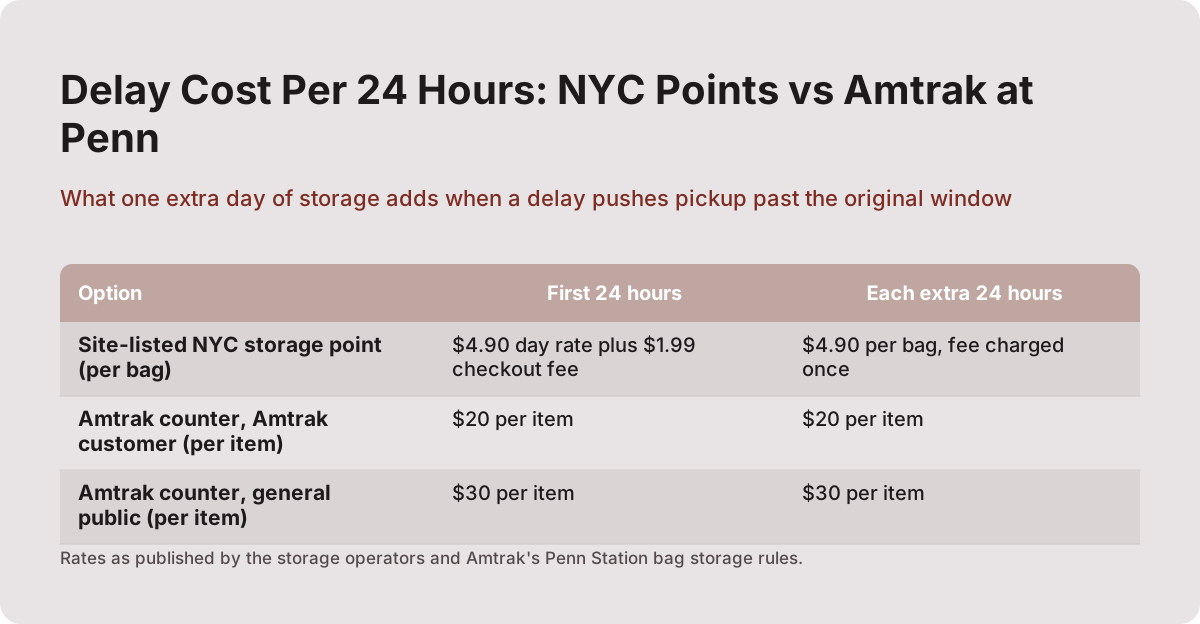
Amtrak's temporary bag storage at Penn Station and Moynihan Train Hall is priced per 24-hour period, $20 per item for Amtrak customers with a ticket and $30 per item for the general public with photo ID, and an item stored longer than 24 hours is simply charged the same rate again at the beginning of each additional period. A delayed train therefore costs one more period, not a forfeited bag.
This is the one left-luggage counter inside a Manhattan transport hub, and its rules are published by Amtrak itself: "Temporary bag storage is available to both Amtrak customers (valid ticket required) and the general public (valid photo ID required)", with those two per-item rates per 24-hour period. The extension language is verbatim on the same page: "For items stored longer than 24 hours, the applicable rate is charged at the beginning of each additional 24-hour period." A delay that turns your one-period booking into two periods is, in Amtrak's own framing, just the rate restarting.
The catch at Penn is not the price, it is the clock on the building. Moynihan Train Hall publishes its own opening hours as 5:00 AM to 1:00 AM daily, and states that during the overnight gap, "Amtrak and LIRR services only available at Penn Station across 8th Avenue." Amtrak publishes no separate hours for the storage counter itself, so the honest position is: the counter has no published hours of its own, the hall around it closes at 1:00 AM, and a 2 AM retrieval is not something any official page promises you. If your delay lands you back at Penn in the small hours, plan for the hall to be shut and the pickup to happen after 5:00 AM.
There is also a wrinkle worth knowing before you rely on the counter. Moynihan's own page says luggage storage "is provided by Amtrak for all passengers, regardless of the railroad operator that you're traveling with", while Amtrak's sitewide page says the general public may use it with photo ID. Two official sources, two framings of who qualifies. Neither page says the service vanishes because your train is late; both are about who can drop a bag in the first place. Quote either one to yourself before you assume you are excluded.
For a traveller whose delay is on the rails rather than in the air, Penn has a second advantage: the LIRR's own timetable rule, "Luggage may not be left unattended", is exactly the rule that makes storage worth paying for, and the same timetable asks that luggage go in overhead racks rather than seat space. If your revised plan involves killing four late hours at Penn with a suitcase, the storage counter plus the waiting room beats dragging the bag to every platform change. The full picture of the counter, including checked baggage, is in the Amtrak baggage and bag storage guide.
What If Your Pickup Falls Between 1 AM And 5 AM?
The gap between 1:00 AM and 5:00 AM is the one window where New York's storage options genuinely thin out. Moynihan Train Hall closes at 1:00 AM, most staffed shop counters keep shop hours, and the only around-the-clock published bag service at a transport hub is Smarte Carte's Terminal 4 counter at JFK, which the operator lists as open 24 hours per day.
Start with what is verifiable. Moynihan Train Hall's hours are its own published "5:00AM - 1:00AM, Daily", with the overnight note that Amtrak and LIRR move across 8th Avenue. At JFK, Smarte Carte publishes Terminal 1 as "Open Everyday / 7:00 AM - 10:00 PM EST" and Terminal 4 as "Open Everyday / 24 hours per day", making T4 the single place in this record where the words "24 hours" attach to a bag storage counter. Those are the two poles: a Manhattan train hall that shuts for four hours, and an airport counter that does not.
| Location | Published hours | Late-night pickup possible? |
|---|---|---|
| Moynihan Train Hall | 5:00 AM to 1:00 AM daily | No, between 1:00 AM and 5:00 AM |
| JFK Terminal 4 (Smarte Carte) | 24 hours per day | Yes |
| JFK Terminal 1 (Smarte Carte) | 7:00 AM to 10:00 PM | No, before 7:00 AM or after 10:00 PM |
| Typical staffed shop counters | Shop hours, published per point | Only within the point's own hours |
The airport option comes with its own conditions, and they are stricter than a shop counter's. Smarte Carte's JFK rules include "Photo ID and Boarding Pass Required", "All Bags Must Be Locked" and "Bags stored for more than 8 hours will be subject to the daily rate", and the Port Authority's own Terminal 4 page adds that storage runs "for a few hours or up to 72 hours" and that "All customers must have a confirmed ticket". A confirmed ticket is a real gate: if your flight is delayed to tomorrow and you have no boarding pass for today, the T4 counter is not a plan. The JFK price, it should be said plainly, is not published anywhere by the operator or the airport; the counter publishes a phone number, 718-916-8963, and calling it is the only honest way to learn the rate.
Getting back to JFK to retrieve a bag has its own delay math. The airport publishes the one-way AirTrain fare as $8.75 to Jamaica or Howard Beach, and the same page notes the system is built for "travelers with mobility devices, strollers, or luggage", with elevators and escalators at the stations. The airport also carries a standing advisory: "Getting to and from JFK may take longer than usual due to construction at the airport. Please allow for significantly more time." When your flight is already late, that sentence is the difference between making the counter and missing it, and the airport said it, not this site.
For the Manhattan midnight scenario, the honest advice is to restructure rather than to hunt. If a delay puts your pickup at 2 AM, no staffed shop counter and the train hall will both be shut, so the workable moves are: collect the bag before the delay bites, if the delay is announced early enough; move the pickup to first thing at 5:00 AM, when the hall reopens; or, if you are flying, never let the bag leave the airport side of your itinerary in the first place. The last day in New York before a night flight guide is built around exactly this sequencing problem.
Does A Delay Change What The Guarantee Covers?
A delay does not weaken the coverage on your booking, but the guarantee's own rules matter more once your timeline slips. The terms cover each stored bag up to EUR 3,000 per claim, claims carry a one-week deadline with a 48-hour police-report requirement, and storing a prohibited item voids the entire claim, electronics included, whenever the pickup happens.
The number to hold onto is the terms figure, EUR 3,000 per bag and per claim. The marketing pages advertise a larger figure, and this site's position is fixed: report the terms number, note that the marketing figure differs, and never call any of it insurance, because the terms themselves say it is not. A delayed pickup does not reduce the EUR 3,000, and it does not extend the claim deadlines, and the second half of that sentence is the one that bites.
The deadlines are the real delay hazard. The published terms give a claim one week and require a police report within 48 hours. If you only discover a problem with your bag three days into a storm-stranded layover, you may already be inside the 48-hour police-report window without knowing it. The practical rule for a delayed traveller is to inspect the bag at pickup, before you leave the counter, and to raise anything wrong on the spot rather than after you have finally reached your hotel at 2 AM.
The prohibited-items list matters here too, because a delay stretches the time your bag sits in someone else's back room, and the terms are explicit that electronics are not accepted for storage at all: "Technological material (iPhone, iPad, Tablet, PC, smartphones)" is on the prohibited list, and a prohibited item voids the entire claim, not just the claim for that item. A delay does not change this rule, but it does change how long you have to regret having slipped a laptop into a bag that was not supposed to hold one. The full breakdown is in the what the guarantee actually covers guide.
There is one more delay-adjacent trap worth naming, because real traveller reporting surfaced it. A guest review on the operator's Trustpilot page, one dated in the same week this site's research ran, complains that the company "refuses to share even an approximate storage address until AFTER you've paid". The honest lesson for a delayed traveller is that you book an area, not a street address, so when a delay forces you to re-plan your route at the last minute, you may not know the exact address until after payment. Build slack into your revised route for that.
How Should You Pick A Storage Point When A Delay Looks Likely?
Pick for the closing time, not the price. The day rate barely varies, $4.90 is the realistic New York rate on 168 of the operator's 178 point cards, so the decision that actually protects you is choosing a point whose published hours comfortably contain your worst-case revised pickup, and which sits on a late-night transit line back to your departure point.
The first filter is published hours, and this site's area pages carry them per point: at Port Authority, 34 of the 36 points within 800 metres publish hours; near Central Park, all 33 do. A point that publishes hours is a point you can plan a delayed evening around. A point that does not is a gamble at 11 PM, and there is no reason to take that gamble when dozens of points a few blocks away do publish.
The second filter is geography after the delay, not before. A delay usually means you are returning to your departure point later and more tired, so the ideal storage point is the one that keeps your final leg short and simple. Near a bus terminal, the Port Authority area puts 36 points within 800 metres of the anchor, rated 4.79 across 2,126 reviews, and the terminal itself is where many delayed coaches actually arrive. Near the World Trade Center, the pool is small, four points within 800 metres rated 4.72 across 201 reviews, but Lower Manhattan is where late airport traffic funnels through, and a small, well-rated pool on your route beats a large one across town.
The third filter is the operator's own honesty about what a booking is. Because you book an area and learn the address after payment, per the traveller reporting above, a delay that forces a route change can leave you working out an address you only just received. When a delay is likely, book the area you are most certain you can reach at your worst-case hour, and screenshot the confirmation before you lose signal in a tunnel.
| Filter | What to check | Why it matters when delayed |
|---|---|---|
| Published hours | The point's own hours on its listing | A closed counter is the only unrecoverable failure |
| Anchor distance | Points within 800 m of your revised route | Shortens the last leg when you are exhausted |
| Reviews with a count | e.g. 4.79 across 2,126 reviews | A real pool signals a real, staffed operation |
| Checkout fee | $1.99 per bag, once | Extra days add $4.90 each, the fee does not repeat |
One caution belongs here because delays make people inventive: the MTA's rulebook has no unattended-property provision, but the Staten Island Ferry rules do state "No person shall leave any property unattended in the terminals or on the ferries", and the Port Authority Bus Terminal rules prohibit abandoning property outright. A delayed traveller's idea of "storing" a bag on a bench is not storage, it is abandonment under published rules, and the fine schedule prices obstruction of seating at $50 and obstruction of traffic at $100. Pay the day rate instead.
What Should You Do The Moment You Learn About The Delay?
Act in this order: confirm the new departure time from the operator, check the storage point's published hours against it, and decide whether to collect early or extend. If the new pickup falls outside the point's hours, the fix is to retrieve the bag before closing today or after opening tomorrow, and the cost either way is the running day rate plus the one-time $1.99 fee.
The first hour after a delay announcement is worth more than the next five. Confirm the delay with the carrier itself rather than a push notification, because gate agents and station staff can tell you the realistic revised time, and the difference between "delayed" and "delayed by six hours" is the difference between one plan and another. Amtrak's own newsroom carries no 2026 change to bag storage at Penn, so the counter's rules you read this morning are still the rules tonight.
Then do the hours math out loud. If the point closes at 8 PM and your revised pickup is 10 PM, you have two clean options: collect before 8 PM today and carry the bag to your late departure, or accept a next-morning pickup and pay the extra day. If the point's hours comfortably contain the new time, do nothing at all, because the extension is automatic and the extra day is $4.90 per bag. The one option that does not exist is talking a closed shop into opening.
Third, if the delay is overnight and the bag is at an airport, check the counter's conditions before you count on it. At JFK, Terminal 4's storage runs up to 72 hours per the Port Authority's own page, but a confirmed ticket is required and the price is not published anywhere, so the phone number is the answer. And if your revised plan means the bag stays at the airport while you sleep in the city, or vice versa, the can I keep my luggage at the airport and go out question has its own answer page.
Finally, write down the pickup address and the point's phone number before your battery dies. A delay scenario is exactly when a dead phone meets an address you never memorised, because you were only supposed to be gone for the afternoon. The staffed counter model protects your bag; it cannot protect your retrieval logistics, and those are on you.

The delay itself is out of your hands. The storage side of it is not: a staffed counter keeps the bag, the day rate keeps running at $4.90, the checkout fee charges once, and the only genuine failure is a door that shut before you got there. Choose the point for its hours, keep the confirmation to hand, and a slipped departure becomes an extra few dollars instead of a lost night. This site, Luggage Storage Lockers in New York City, publishes the per-point hours for exactly this reason.
Common Questions About Delays And Late Pickup
What happens to my stored bag if my flight is delayed overnight?
Nothing happens to the bag. Staffed storage points hold it and the day rate keeps running, $4.90 per bag per day plus the one-time $1.99 checkout fee, so an overnight delay adds one more day rate per bag. The only risk is the point's closing time, so check its published hours against your revised pickup.
Does luggage storage in New York charge a penalty for late pickup?
No published terms impose a late penalty. The rate is per day, so a late pickup simply costs the running day rate, and the $1.99 checkout fee is charged once per bag rather than per night. Amtrak's counter at Penn states the same principle in its own words: the applicable rate is charged at the beginning of each additional 24-hour period.
Can I pick up my bag from Penn Station storage at 2 AM?
Not from Moynihan Train Hall. The hall publishes its hours as 5:00 AM to 1:00 AM daily, and Amtrak publishes no separate overnight hours for the storage counter, so a 2 AM retrieval is not promised anywhere. Plan the pickup for after 5:00 AM, when the hall reopens.
Is any New York bag storage open 24 hours?
One is, in this record: Smarte Carte's Terminal 4 counter at JFK, published as "Open Everyday / 24 hours per day". It requires photo ID and a boarding pass, bags must be locked, and the price is not published, so call the counter at 718-916-8963 before you rely on it.
Do I lose the guarantee if my pickup is late?
No, the guarantee's value, EUR 3,000 per bag per claim in the terms, does not shrink because you came back late. But the deadlines do not stretch either: claims carry a one-week window and a 48-hour police-report requirement, so inspect the bag at pickup and raise any problem immediately.
What if my delay means the storage point is closed when I arrive?
The bag stays put and you return within the point's next open hours. Staffed counters do not dispose of bags on a timer. To avoid the situation entirely, pick a point whose published hours contain your worst-case revised pickup, and if a late-night retrieval is possible, favour areas on late-night transit lines.