24 Hour And Late Night Luggage Storage In NYC: What Stays Open
A storage point that closes at 8pm is useless to a passenger flying out at 2am. Here is what New York actually offers after dark, hub by hub, with the hours each operator publishes.
Short answer
True around-the-clock bag storage in New York exists in one verified place: Smarte Carte's Terminal 4 counter at JFK, open 24 hours. Amtrak's staffed counter at Penn Station stores bags for $30 per item per 24 hours for the general public with photo ID, $20 with a ticket. Citywide staffed storage points typically run $4.90 per bag per day plus a $1.99 checkout fee.
A storage point that shuts at 8pm is not a storage point for a red-eye passenger. It is a place that holds your bag until it decides to stop holding it, and the difference only becomes visible at 11pm when you are standing outside a shuttered shop with a suitcase and a cab to catch. New York publishes enough information to plan around this, but almost none of it is gathered in one place. The hours sit on individual point listings, the rail rules sit in PDFs, and the one genuinely around-the-clock counter in the city sits at an airport, not a station.
This guide puts the late-night picture together. It covers what a 24 hour storage day costs, which station areas keep the latest pickup windows, what the rules say about leaving a bag overnight, and how the airports handle bags for passengers flying at hours no shop keeps. Every hour and every price below comes from an operator's own published page, and where an operator publishes nothing, that gap is stated rather than filled.
What Does 24 Hour Luggage Storage In NYC Actually Cost?
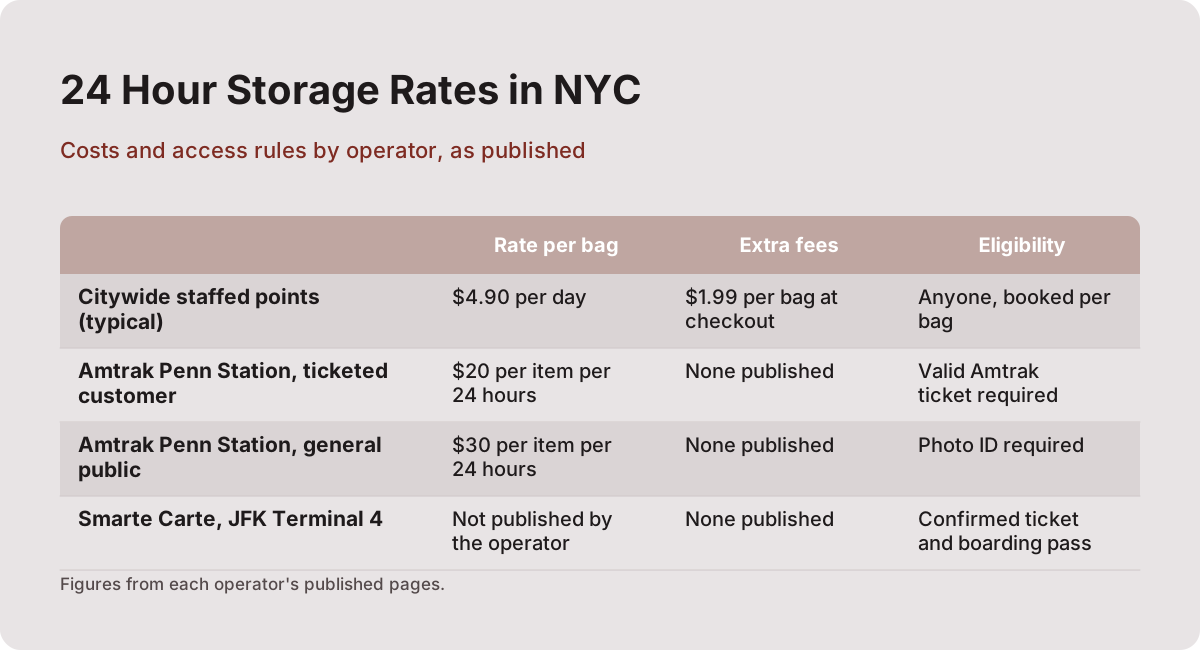
A full 24 hour day of staffed storage in New York typically costs $4.90 per bag plus a $1.99 per-bag checkout fee, so $6.89 all in for one bag, and $16.69 for one bag across three days because the fee is charged once per bag. Amtrak's counter at Penn Station is the priced exception: $20 per item per 24 hours with a valid ticket, $30 per item for the general public with photo ID.
The two systems price differently, and the difference matters more at night than during the day. A staffed storage point in the city network charges a flat day rate per bag, and the day is measured from drop-off, so a bag checked at 9pm is due back by 9pm the following evening. Amtrak prices per 24 hour period too, but its own page spells out what happens after that: "For items stored longer than 24 hours, the applicable rate is charged at the beginning of each additional 24-hour period." That is a clean rule for a passenger whose flight slips a day.
What no operator publishes is a late-night surcharge, because there isn't a separate product called late-night storage at all. There are only points whose published hours happen to run late, and they charge the same rate as their neighbours that close early. The planning work is therefore not about price. It is about matching a point's pickup window to your departure, which the rest of this guide does area by area.
| Storage option | Rate per bag | Extra fees | Who can use it |
|---|---|---|---|
| Citywide staffed points (typical) | $4.90 per day | $1.99 per bag at checkout | Anyone, booked per bag |
| Amtrak, Penn Station, ticketed customer | $20 per item per 24 hours | None published | Valid Amtrak ticket required |
| Amtrak, Penn Station, general public | $30 per item per 24 hours | None published | Photo ID required |
| Smarte Carte, JFK Terminal 4 | Not published by the operator | None published | Confirmed ticket and boarding pass required |
One honest gap in that table deserves its own sentence. Smarte Carte publishes hours, rules and a phone number for its JFK counters but no rate, and two separate attempts to extract a price from its booking flow returned pages with no dollar figures on them at all. The operator's published phone number for the service is 718-916-8963, and calling it is the only way to learn the JFK price in advance. Nobody can tell you that price from a website, and any page that prints one is guessing.
Which Storage Points Stay Open Late Around Penn Station?
Penn Station has 27 staffed storage points within 800 m of its anchor, rated 4.84 across 3583 reviews, and 25 of them publish their opening hours, which makes it the most transparent late-night inventory in the city. None of the 27 is a locker: every single one is a staffed counter in a shop, hotel or service business, so its late-night availability depends on when a human is behind the counter.
The staffed-counter detail is not a technicality. A locker bank stays available for as long as the building around it stays open, but a staffed counter closes when its staff goes home, and a point that publishes hours until 10pm means exactly that. This is why the site counts how many points publish hours at all: 25 of 27 around Penn Station do, so a late-night reader can check a real window before booking rather than discovering it on arrival.
The station's own late-night geometry is worth understanding before you pick a point. Moynihan Train Hall publishes its public hours as 5:00AM to 1:00AM daily, and its own page notes that overnight, from 1:00AM to 5:00AM, Amtrak and LIRR services move across the avenue to the original Penn Station. A traveller retrieving a stored bag at 2am is therefore dealing with a building that is partly shut, whatever the storage point's own clock says. Amtrak's checked baggage window at Penn runs 5:00 AM to 10:00 PM, so the staffed rail counter is not a 2am option either.
For luggage storage specifically, Moynihan's own page says: "Luggage storage is provided by Amtrak for all passengers, regardless of the railroad operator that you're traveling with. Please visit the Amtrak Customer Service desk to arrange luggage storage." Note the honest wrinkle: Amtrak's sitewide page says the general public may use temporary bag storage with photo ID, while Moynihan says "all passengers". Two official pages, two different qualifications. Quote both, trust the narrower one, and bring photo ID regardless.
For a fuller treatment of the rail side of this, including checked baggage, carry-on limits and Red Cap service, see the companion guide on Amtrak baggage and bag storage at Penn Station. For the wider question of keeping a bag for several nights rather than one long day, read overnight and multi-day bag storage in NYC, which covers the per-24-hour billing rules in depth.
What About Port Authority And The Downtown Areas After Dark?
Port Authority has 36 staffed storage points within 800 m of its anchor, rated 4.79 across 2126 reviews, and all 34 that publish hours list them on their cards, which is the deepest published-hours inventory of any station area. The terminal itself provides no storage of any kind: the Port Authority states plainly that it does not provide baggage storage facilities at the bus terminal, and its FAQ repeats the answer.
That official sentence deserves to be quoted the way the operator wrote it. The terminal's own page says, under Services: "Baggage Storage: The Port Authority of NY and NJ does not provide baggage storage facilities at the bus terminal." The FAQ goes further and answers the locker question directly, then adds that your bus carrier may have limited storage capacity and to check with the carrier. So the terminal offers nothing, the carriers offer nothing published, and the 36 staffed points around it are the real answer for a late-night bus passenger.
Downtown, the picture thins out sharply. The World Trade Center area carries only 4 storage points within 800 m, rated 4.72 across 201 reviews, and all 4 publish hours. Four points is a small inventory, and a late-night reader downtown should check the published hours on each card before assuming any of them runs past early evening. The trade-off is real: downtown points sit close to the 9/11 Memorial, which caps bags at 19 x 17 x 8 inches on the Memorial itself and stores larger items in its Coat Rooms for the duration of a visit, so a downtown bag drop pairs naturally with a morning at the Memorial rather than a midnight pickup.
The one rule from the terminal worth knowing even if you never enter it comes from the Port Authority's own binding rules PDF: "No person shall abandon any property at the Terminal." Abandonment is prohibited even though storage is absent, which closes the tempting loophole of leaving a bag by a pillar for a few hours. Nobody at the terminal will hold it, and nobody may leave it.
If your night actually starts at a bus departure rather than a train, the surrounding blocks give you the widest choice of staffed counters in the city. The trade is straightforward: more points, more published hours, but a terminal building that offers nothing itself and pushes every bag question back onto the private network around it.
What Do The Rules Say About Leaving A Bag Overnight In New York?
The MTA's Rules of Conduct contain no unattended-property provision at all: a full-text search returns zero matches for "unattended" and zero for "abandon". The rulebook's only hard dimension is thirty inches, and it applies to wheeled carts, not suitcases. The LIRR does publish a luggage rule, and the Staten Island Ferry prohibits leaving property unattended, each in its own words.
The subway finding is the genuinely surprising one, because most travel content asserts the opposite. The MTA rulebook, 21 NYCRR Part 1050, was opened directly for this site's research, and it simply does not ban an unattended bag. What it does contain is Section 1050.9(g), which bars any wheeled cart greater than thirty inches in either length or width, and any item that extends outside a subway car window or door, interferes with passenger traffic, or endangers others. The fine schedule prices these at $75, with $50 for obstructing seating, facilities, elevators or escalators, and $100 for obstruction of operations or traffic. Those are real dollar figures from the authority itself, and they attach to behaviour, not to suitcase size.
The MTA's own rider guide is blunter about the practical advice, in the agency's own voice: "Don't travel with more than you can carry on your own, and avoid rush hour if you're transporting something big. Make space for other riders and don't block doors, stairs, or passageways." That is the best reason-to-store sentence in the whole record, and it comes from the agency, not from any storage company. The full regulation text is published by the MTA at its official document library.
The commuter rail side is different again. The LIRR's current City Terminal timetable, marked effective March 23, 2026, publishes its own luggage rule: "Luggage should be stored in overhead racks and not take up seat space or block the aisles or doorways of trains. Luggage may not be left unattended. Bags and containers are subject to random search by MTA police." For a Penn Station reader, that is the rule that bites: the railroad expects bags to stay with you or go into storage, not onto a seat.
The Staten Island Ferry's passenger rules, issued by order of the NYC DOT Commissioner, add rule 8: "No person shall leave any property unattended in the terminals or on the ferries or place property on the floors that may interfere with pedestrian traffic or waiting areas." The ferry's own storage position is unstated and cannot be asserted either way, but its unattended-property rule is real and published at the NYC DOT rules page.
The pattern across all of them is consistent: no operator offers overnight self-service storage, and every operator that addresses bags at all tells you to keep them with you. That is precisely why the staffed-point network exists, and why its published hours are the number that matters after dark.
How Do You Book A Point Around A Red-Eye Pickup Window?
You match the point's published hours to your departure, not the other way round: pick the point whose closing time sits at least an hour after your planned pickup, book it for the day you actually need, and treat any point that publishes no hours as unavailable for a night plan. In the Times Square area, 42 of the 44 storage points within 800 m publish hours, the deepest transparency of any area in the city.
The booking mechanics are simple and the same everywhere: a per-bag day rate of $4.90, a $1.99 per-bag fee at checkout, and a card that shows the point's hours before you pay. What the card does not always show is the exact street address. Traveller reporting on the operator's public review profile includes a detailed complaint that the company "refuses to share even an approximate storage address until AFTER you've paid", which is a real expectation-setting point: you are booking a point in an area, and the specific address arrives with the booking. For a daytime drop that is a minor quirk. For a 2am pickup it is the difference between a two-block walk and a fifteen-block one, so read the address the moment the booking confirms.
The operator itself now disclaims its own advertised floor price, in its own words: "Prices start from $2.90 per bag. This is the lowest currently available city price, not a promise that every location or bag category has the same rate." That is the company confirming what this site measured independently: 168 of 178 real New York point cards show $4.90, and $4.90 is the rate a reader should expect. The $2.90 string is advertising, and the fee comes on top in every case.
One more overnight wrinkle is worth naming. The terms that bind a booking prohibit storing electronics entirely, with the prohibited list including, verbatim, "Technological material (iPhone, iPad, Tablet, PC, smartphones)". A laptop is not a storable item under those terms, and the prohibition voids any claim if it is breached. For a night flight passenger who planned to leave a work bag, that rule changes the plan entirely, and it is covered in more depth in what you cannot leave in a stored bag in New York.
| Departure type | Pickup window to plan for | What to check before booking |
|---|---|---|
| Red-eye flight, 11pm to 5am | Point open past your airport departure time | Published hours on the card, plus transfer time to the airport |
| Late train, 10pm to 1am | Point open past 10pm | Hours, and walking distance from the station |
| Overnight layover | Storage for a full 24 hours plus buffer | Per-24-hour billing terms, next-day opening time |
| Early morning cruise or tour | Point opens before your pickup | Morning opening time, not just closing time |
The early-morning row is the one people forget. A point that opens at 9am is as useless to a 7am pickup as a point that closes at 8pm is to a midnight one, and the published hours on each card run in both directions. Check the opening time with the same care as the closing time.

Can The Airports Hold Your Bag Through The Night?
JFK is the only New York airport with verified bag storage, and only Smarte Carte's Terminal 4 counter runs around the clock: the operator publishes "Terminal 4 Open Everyday / 24 hours per day". Terminal 1 runs 7:00 AM to 10:00 PM. LaGuardia and Newark list no baggage storage in their own services at all.
The Terminal 4 line is the only place this site may write anything like "around the clock", and it belongs to the operator. Smarte Carte's own page sets the conditions: photo ID and boarding pass required, all bags must be locked, full payment on drop-off, no flammable materials or alcohol, firearms and perishables prohibited, and all bags screened in accordance with TSA safety guidelines. The Port Authority's own Terminal 4 page adds the duration rule: bags can be stored "for a few hours or up to 72 hours", with a confirmed ticket required regardless of which terminal you are flying from. The operator's published phone number for the service is 718-916-8963, and since no page publishes the price, calling is the honest route to a rate.
Two honest contradictions sit beside that. First, Smarte Carte publishes a Terminal 1 counter with its own hours, while the airport's own Terminal 1 page contains no mention of baggage storage at all; both are official, and both halves are stated. Second, bags stored more than 8 hours are subject to the daily rate, per the operator's own footnote, so a long overnight stay is priced as a day, not as hours.
LaGuardia and Newark answer differently. LaGuardia's services page lists baggage carts, a baggage office and oversized baggage, with no storage entry, and its own FAQ answers the storage question with carts and porters. Newark's identically structured list also carries no storage entry. Neither airport publishes a denial, so the honest wording is that each lists none, not that each says there is none. For the full airport-by-airport treatment, see JFK airport bag storage and the companion guides for Newark and LaGuardia.
Getting to JFK with a bag has its own published numbers. The airport's own page states the one-way AirTrain fare between JFK and Jamaica or Howard Beach is $8.75, and says the system is accessible for "travelers with mobility devices, strollers, or luggage", with elevators and escalators at the stations. The same page carries a standing advisory worth quoting whole: "Getting to and from JFK may take longer than usual due to construction at the airport. Please allow for significantly more time." For a night pickup planned to the minute, that sentence is the airport telling you not to plan to the minute. The full details are on the airport's own AirTrain page.
| Airport | Storage listed in own services | Hours published | Conditions published |
|---|---|---|---|
| JFK | Yes, baggage storage listed | T1: 7:00 AM to 10:00 PM; T4: 24 hours | Photo ID, boarding pass, bags locked, TSA screening |
| LaGuardia | No storage entry | n/a | Airport FAQ points to carts and porters |
| Newark | No storage entry | n/a | None published |
How Should You Plan A Full Late-Night Storage Day?
Work backwards from your pickup time, add an hour of buffer, and choose the area whose published hours clear both: Penn Station for the deepest staffed inventory, Port Authority for the most published hours, Times Square for late-evening coverage, and JFK Terminal 4 as the city's only around-the-clock option. One bag for one day costs $6.89 all in across the citywide network, or $30 at Amtrak's counter without a ticket.
The buffer is not padding, it is the lesson of every published advisory in this record. The airport says allow significantly more time because of construction. The MTA says avoid rush hour if you are transporting something big. Moynihan's own page says the hall closes to the public between 1:00AM and 5:00AM. Each operator is telling you, in its own words, that the plan on paper and the night on the street are different things, and the hour you did not schedule is the hour you will need.
There is also a question this guide cannot answer for you, and it is better named than guessed at: why New York's transport hubs have no public lockers at all. No primary source explains it, and this site does not repeat the folk explanation other pages print. What can be said is verifiable and current: no hub added a locker bank or storage concession in 2025 or 2026, the city's genuine public lockers are at a tennis centre, a museum coat area and a national monument, and none of them is a luggage option near a station. The honest inventory is the one this guide has laid out: staffed counters with published hours, one rail counter with a published price, and one airport counter that never closes.
For the wider planning picture, including how a delayed train or flight changes a storage booking, see what happens if your train or flight is delayed. The site's own inventory, Luggage Storage Lockers in New York City, covers all 8 areas and 88 distinct staffed points with their published hours, and every late-night question in this guide resolves to checking one of those cards against your departure.
Common Questions About 24 Hour Luggage Storage In NYC
Is there any luggage storage in NYC open 24 hours?
One verified place: Smarte Carte's Terminal 4 counter at JFK, which the operator publishes as open 24 hours per day, every day, with photo ID and a boarding pass required. No New York transport hub, museum or staffed city point publishes a comparable around-the-clock window. Amtrak's Penn Station counter is the closest station option, but its checked baggage window runs 5:00 AM to 10:00 PM, and Moynihan Train Hall itself is open to the public only from 5:00AM to 1:00AM.
How much does 24 hour luggage storage cost in NYC?
A staffed city point typically charges $4.90 per bag per day plus a $1.99 per-bag checkout fee, so $6.89 all in for one bag for one day. Amtrak's counter at Penn Station charges $20 per item per 24 hours with a valid ticket, or $30 per item for the general public with photo ID, with each additional 24 hour period charged at the start of that period. JFK's price is not published by the operator; the published phone number for the service is 718-916-8963.
Can I pick up a stored bag after midnight in New York?
Only at JFK Terminal 4, whose counter never closes. In Manhattan, Moynihan Train Hall shuts to the public between 1:00AM and 5:00AM, Amtrak's checked baggage window closes at 10:00 PM, and every staffed city point closes when its own published hours say it does. Around Penn Station, 25 of the 27 staffed points publish hours, so check the card before booking and treat any point with no published hours as unavailable for a midnight plan.
Are there lockers I can use overnight in NYC?
No transport hub in New York publishes a public locker bank, and none was added in 2025 or 2026. The genuine public lockers in the city are a seasonal tennis permit at the Central Park Tennis Center, day lockers at the American Museum of Natural History for coats and small bags, and the 25-cent, 2-hour coin lockers at the Statue of Liberty monument, none of which accepts a suitcase. Every staffed storage point in the citywide network is a counter with a person, not a locker.
Do storage points charge extra for late-night hours?
No operator publishes a late-night surcharge, because late-night storage is not a separate product. Points that happen to keep late hours charge the same $4.90 day rate plus the $1.99 checkout fee as points that close early. The only after-8-hours rule in the record is Smarte Carte's at JFK: bags stored for more than 8 hours are subject to the daily rate.
What happens if my flight is delayed past the point's closing time?
The point's published hours still apply, so a bag left past closing is a pickup problem, not a billing one. Amtrak's terms are the cleanest published answer for a slipped schedule: each additional 24 hour period is charged at the beginning of that period, so a one-day slip costs one more day at the same rate. For the fuller treatment of rebooking and delays, see the companion guide on what happens if your train or flight is delayed.