Taking Luggage On The Subway And Commuter Rail In New York
The MTA rulebook puts exactly one measurement on what a rider may carry, and it is about wheeled carts, not suitcases. Here is what the rules really say, what the fines are, and when storing a bag beats dragging it.
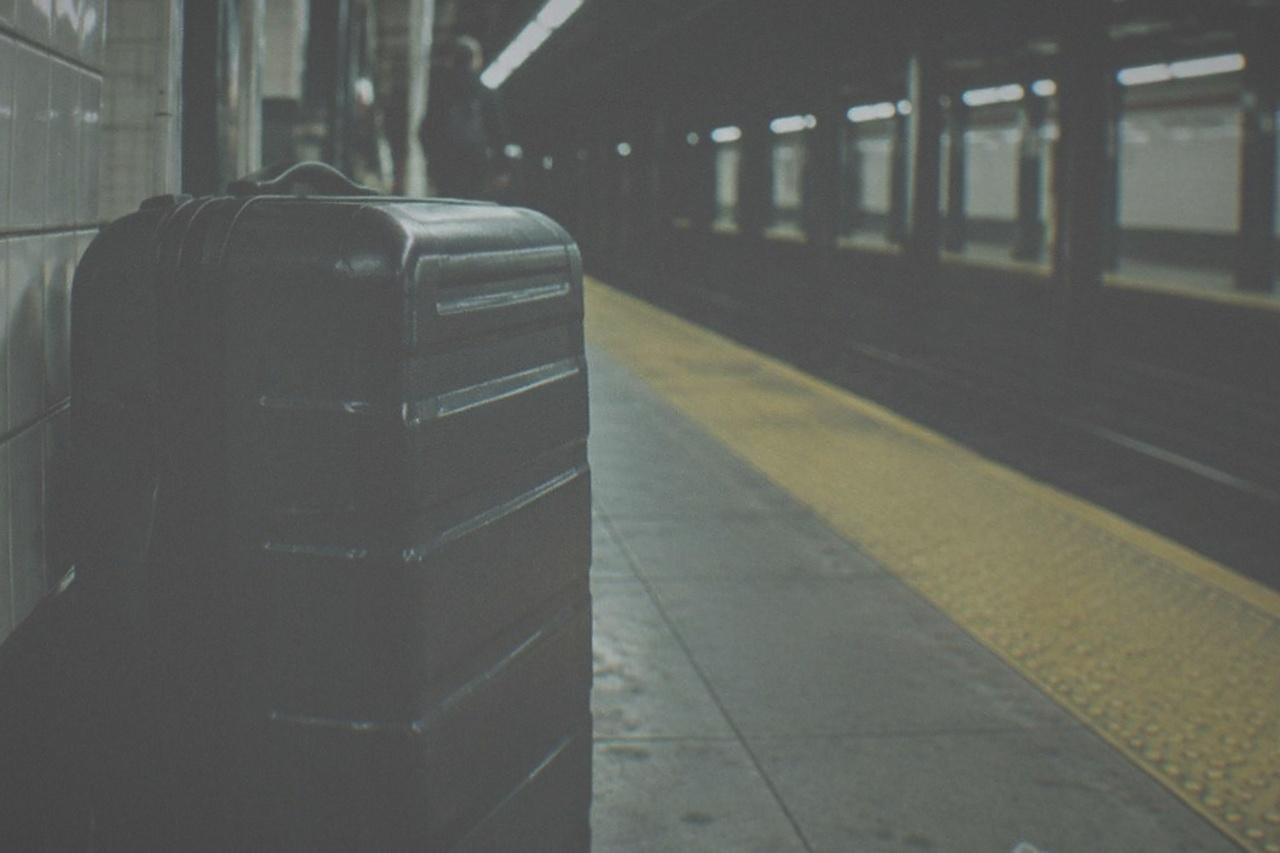
Short answer
New York's subway has no suitcase size limit. The only dimension in the MTA rulebook is thirty inches, and it applies to wheeled carts, not luggage. Fines run $50 to $100 for blocking seats, doors or traffic. The LIRR bans unattended bags. Storing a bag near a station costs from $4.90 per day plus a $1.99 checkout fee.
A suitcase on a New York subway platform is a common sight and a legal grey zone, which is a strange combination for something millions of people do every week. The Metropolitan Transportation Authority publishes a full rulebook, 21 NYCRR Part 1050, and it contains exactly one measurement governing what a rider may carry. That measurement is thirty inches, and it applies to wheeled carts, not to luggage. Everything else in the rules is a behaviour test: does the item block a door, a stairway, a seat or an aisle. If it does, the rule is against the behaviour, not the bag.
This guide walks through what each New York operator actually publishes about travelling with bags: the subway rules and their real dollar fines, the Long Island Rail Road's own luggage rule, the Staten Island Ferry's property rules, and Amtrak's carry-on limits for anyone changing between systems at Penn Station. It also covers the honest gap: what no operator publishes, including any rule for NJ Transit baggage, where nothing sourced exists in either direction. Along the way it flags the moments when the arithmetic flips, because a reader wrestling two cases through a turnstile is one sentence away from realising it is cheaper to store one of them.
Can You Take A Suitcase On The New York Subway?
Yes, and the MTA rulebook sets no size limit on luggage. The only dimension anywhere in Part 1050 is thirty inches, and it applies to wheeled carts, not suitcases. The rules that actually bite a traveller with a bag are behavioural: nothing may block doors, stairs, passageways or seats, and a $50 fine attaches to obstructing seating, facilities, elevators or escalators. A suitcase is legal; a suitcase sprawled across two seats is not.
Section 1050.9(g) of the MTA Rules of Conduct is the load-bearing text. It bars any person from bringing onto a facility or conveyance "any wheeled cart greater than thirty inches in either length or width, including but not limited to shopping or grocery store carts or baskets", with an explicit exception for strollers carrying children. It then bars any item that extends outside the window or door of a subway car or bus, any item that "constitutes a hazard to the operation of the authority, interferes with passenger traffic, or impedes service", and any item that is "a danger or hazard to other persons". Read the full provision in the authority's own document, the Combined Fines and NYCTA Rules PDF hosted on mta.info.
Notice what is absent. There is no suitcase dimension. There is no weight limit. There is no bag-count limit. A traveller with a 28-inch wheeled case is carrying an item the rulebook never measures, and the only questions that matter are whether it fits through the door, whether it blocks anyone, and whether it sits on a seat another rider needs.
The MTA's own rider guide translates the rule into plain words, and it adds a piece of advice aimed squarely at the person dragging a big case: "Don't travel with more than you can carry on your own, and avoid rush hour if you're transporting something big. Make space for other riders and don't block doors, stairs, or passageways." Under what you cannot bring, the guide lists "Large wheeled carts. Carts that are larger than 30 inches in length or width are not allowed" and "Anything that is so long it sticks out of a subway window or door." That is the agency itself, in its own voice, on the official riding-the-subway guide, telling travellers not to haul more than they can manage.
What Are The Fines For Blocking Seats Or Doors With A Bag?
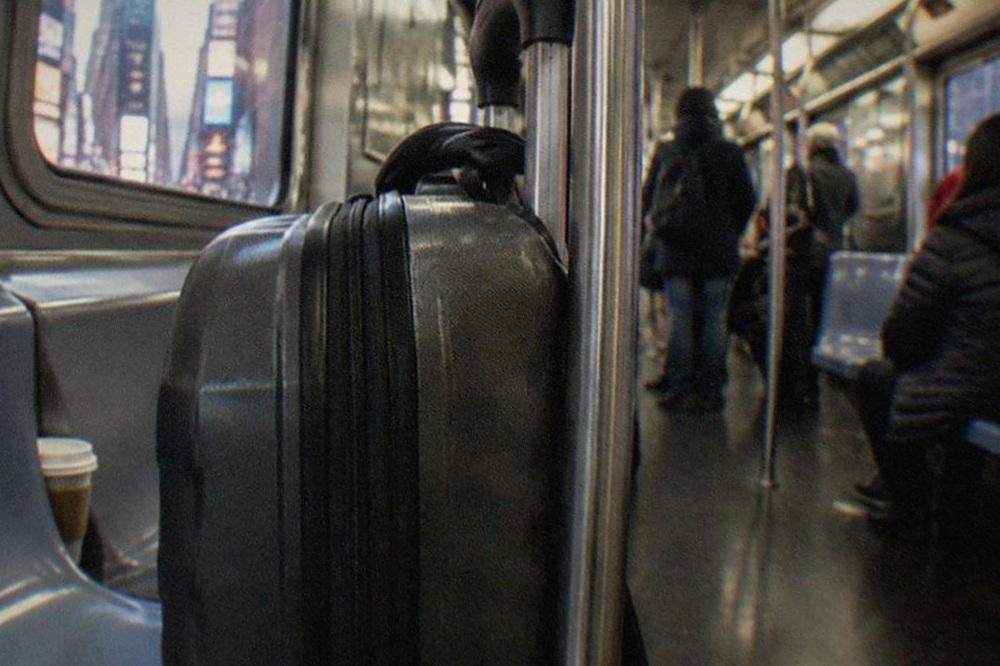
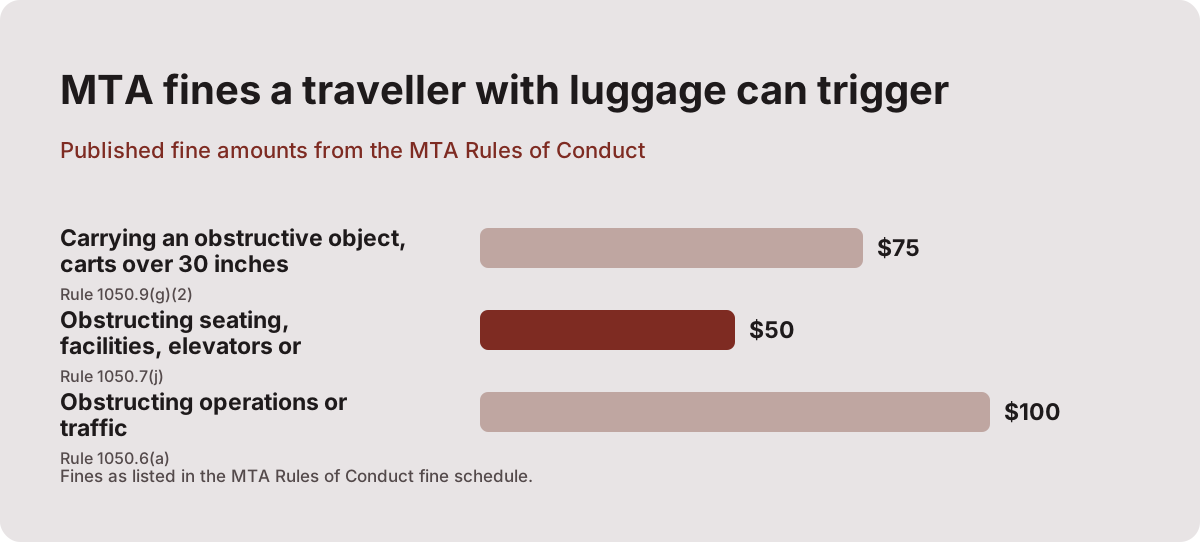
The same MTA document that sets the rules also prices the offences. Carrying an obstructive object, including a cart over thirty inches, carries a $75 fine. Obstructing seating, facilities, elevators or escalators carries $50. Obstructing operations or traffic carries $100. Section 1050.7(j)(1) separately forbids occupying more than one seat in a way that interferes with other passengers' comfort, which is the rule that catches a suitcase parked on the seat beside its owner.
These are real dollar amounts published by the authority itself in its fine schedule, not third-party summaries. The three figures that matter to a traveller with luggage are the $75 obstructive-object fine, the $50 seat-obstruction fine and the $100 operations-obstruction fine, and each attaches to something a person with a heavy bag can genuinely do wrong on a crowded platform.
| Offence | Rule | Fine |
|---|---|---|
| Carrying a long object that extends outside a door or window | 1050.9(g)(1) | $75 |
| Carrying an obstructive object, including carts over 30 inches | 1050.9(g)(2) | $75 |
| Carrying a hazardous object | 1050.9(g)(3) | $75 |
| Obstructing seating, facilities, elevators or escalators | 1050.7(j) | $50 |
| Obstructing operations or traffic | 1050.6(a) | $100 |
The seat rule deserves its own sentence because it is the one riders break most often without thinking. Section 1050.7(j)(1) forbids anyone to "occupy more than one seat on a station, platform or conveyance when to do so would interfere or tend to interfere with the operation of the transit system or the comfort of other passengers." A suitcase on a seat is a second occupied seat. In an empty car at midday nobody will say anything. At 8:30 on a weekday morning, it is a $50 offence and a guaranteed argument.
There is one more finding worth knowing, and almost no page about New York bags carries it. The MTA Rules of Conduct contain no provision about unattended or abandoned property at all. A full-text search of the rulebook returns zero matches for "unattended" and zero for "abandon". The subway rulebook simply does not address the abandoned-bag question. That is not permission to walk away from a suitcase on a platform, and no reader should take it as such. It is simply an honest negative: other New York operators do publish unattended-property rules, and the MTA does not.
Does The LIRR Have Its Own Luggage Rule?
Yes, and it is published in the railroad's own City Terminal timetable, marked effective March 23, 2026. Verbatim: "Luggage should be stored in overhead racks and not take up seat space or block the aisles or doorways of trains. Luggage may not be left unattended. Bags and containers are subject to random search by MTA police." That is stricter than the subway rulebook on one point: the LIRR bans unattended luggage outright.
Most readers carrying a bag at Penn Station or Grand Central Madison are changing to or from a Long Island Rail Road train, so this is the rule that actually governs their trip. The current LIRR City Terminal timetable carries the luggage rule in its published notices, and it does three distinct things. It tells riders where bags belong, in the overhead racks. It forbids seat space, aisles and doorways. And it makes two statements the subway rulebook never makes: luggage may not be left unattended, and bags are subject to random search by MTA police.
The unattended-bag clause is the honest hook into why storage points exist at all. A rider who wants to leave Penn Station for the afternoon cannot park a case on a LIRR train or a platform bench and walk away. The rule forbids it, the ferry rules forbid it at the terminals, and the 9/11 Memorial's guidelines subject unattended bags to search and removal. The only sanctioned way to leave a bag behind in New York is to hand it to someone whose business is holding it.
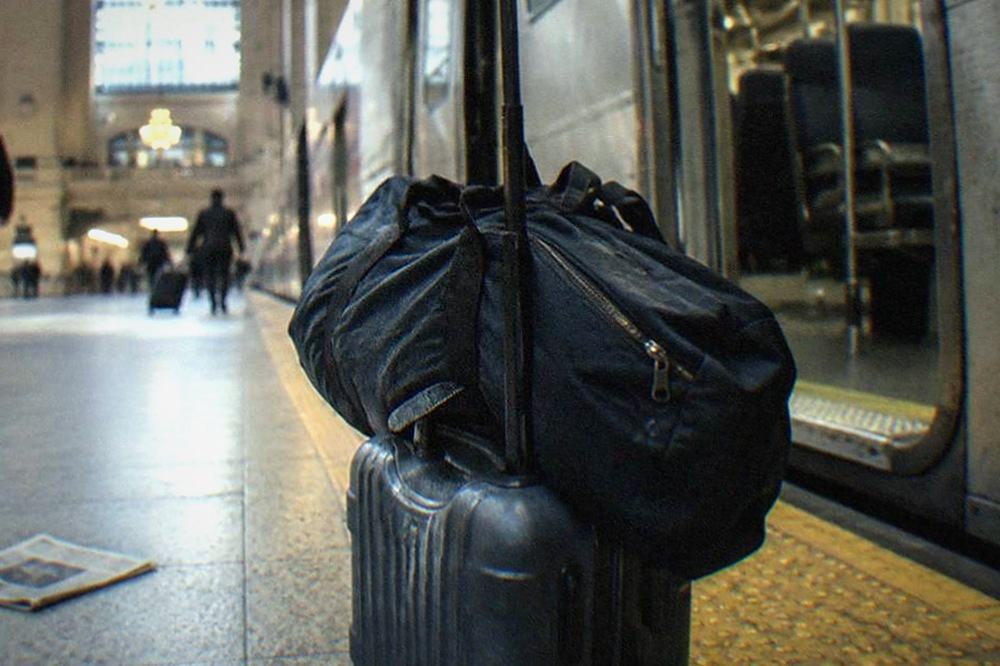
That is where the arithmetic starts. A staffed storage point near a Manhattan station typically charges $4.90 per bag per day plus a $1.99 per-bag checkout fee, so one bag for one day comes to $6.89 all in. Amtrak's staffed bag storage at Penn Station, covered in detail on the Amtrak baggage and bag storage at Penn Station guide, charges $20 per item per 24 hours for Amtrak customers and $30 for the general public with photo ID. Neither is free, but both are cheaper than a fine, and both are cheaper than the alternative of a ruined afternoon spent guarding a case in a waiting room.
What Do The Ferry And Bus Terminal Rules Say About Bags?
The Staten Island Ferry's passenger rules, issued by order of the NYC DOT Commissioner, state that "No person shall leave any property unattended in the terminals or on the ferries or place property on the floors that may interfere with pedestrian traffic or waiting areas." The Port Authority Bus Terminal rules likewise prohibit abandoning any property at the terminal. Both are rules about property and behaviour, and neither operator publishes any storage service.
The ferry rules add a seat clause that mirrors the MTA's: "No person shall occupy more than one seat. No person shall place personal belongings on seats and benches so as to interfere with their use by others." The rules end with a compliance warning that a person who fails to comply "may be subject to arrest, summons and/or may be prohibited from boarding the ferry and/or removed from the terminal." Read them in full at the NYC DOT ferry passenger rules PDF on nyc.gov. One limit matters: these are rules about property, not a statement about whether the ferry has storage. The ferry's storage position is unstated, and this site does not assert it in either direction.
The Port Authority Bus Terminal publishes its own binding rules. Baggage is defined as "hand carried items such as luggage, backpacks, suitcases and duffel bags", and rule 3 states plainly: "No person shall abandon any property at the Terminal." The same document bars any baggage "of such weight or size such that it cannot reasonably be carried by one person using a single handcart." The terminal itself provides no storage, a position the Port Authority states in two separate places, and it explicitly defers storage questions to the individual bus carriers.
The honest gap in this whole cluster is NJ Transit. Research for this site opened the MTA rulebook, the LIRR timetable, the ferry rules and the Amtrak policies, and found no opened, verified NJ Transit luggage rule of any kind. Nothing sourced says what NJ Transit permits or forbids for bags, so this guide says nothing in either direction. A reader changing to a NJ Transit train at Penn Station should treat the Penn Station rules, the LIRR notices and plain common sense as the operating baseline and ask the crew if in doubt.
For a rider arriving at one of the big Manhattan hubs with two cases, the practical fallback is a staffed storage point within walking distance of the platform. The table below shows what this site measures around the three busiest station anchors, using the 800-metre radius that defines each area's inventory.
| Station area | Storage points within 800 m | Rating | Typical rate per bag per day |
|---|---|---|---|
| Penn Station | 27 | 4.84 across 3,583 reviews | $4.90 plus $1.99 checkout fee |
| Port Authority | 36 | 4.79 across 2,126 reviews | $4.90 plus $1.99 checkout fee |
| Grand Central | 14 | 4.7 across 502 reviews | $4.90 plus $1.99 checkout fee |
Every one of those points is a staffed counter, not a locker, which is the honest finding this site's whole record supports. The Penn Station vs Grand Central vs Port Authority guide compares the three hubs in full, including what each operator publishes about storage inside the terminal itself.
What Are Amtrak's Carry-On Limits At Penn Station?
Amtrak allows each passenger one personal item up to 25 lbs and 14 x 11 x 7 inches, plus two carry-on items up to 50 lbs and 28 x 22 x 14 inches each. A $20 excess baggage fee applies per item above the limits, with a maximum of two excess bags. Amtrak also publishes a direct instruction: "Do not store items in empty seats, aisles, vestibules or other areas."
These limits matter to a subway rider only because Penn Station is where the systems meet, and because a bag that qualifies as an Amtrak carry-on is roughly the largest case anyone should attempt on a rush-hour 2 train. The dimensions come from Amtrak's own carry-on baggage policy, which also notes that passengers must be able to lift carry-on items over their heads onto the luggage shelf, that personal items must fit under the seat, and that bags must fit the station sizer.
Amtrak's temporary bag storage is the one genuine left-luggage service inside a Manhattan transport hub. It costs $20 per item per 24 hours for Amtrak ticket holders and $30 per item for the general public with photo ID, and it is the reason a rider with an afternoon to kill at Penn Station has a sanctioned option that the LIRR, the subway and the ferry all lack. There is an honest wrinkle about who qualifies: Amtrak's own page says the general public may use it with valid photo ID, while Moynihan Train Hall's page says luggage storage is provided "for all passengers, regardless of the railroad operator that you're traveling with". Two official sources, two wordings. Quote both, trust the narrower one.
For a rider weighing the two options at Penn Station, the choice usually comes down to how long the bag needs to sit and whether a train ticket is in hand. The station-side counter is the only in-terminal option, and the surrounding staffed points are the cheaper one for anything beyond a few hours.
When Is It Cheaper To Store A Bag Than To Carry It?
The maths turns on the second bag and the length of the trip. One bag, one day at a staffed storage point costs $6.89 all in, the $4.90 day rate plus the $1.99 checkout fee. A $50 seat-obstruction fine equals about seven bag-days. A $100 operations fine equals about fourteen. If a trip involves rush hour, a transfer and two cases, storing one is usually the cheaper plan.
The comparison table below puts the published figures side by side. The storage figures are this site's own measured New York rates, the Amtrak figures come from Amtrak's published rate card, and the fine figures come from the MTA's own schedule.
| Option | Cost | Source |
|---|---|---|
| Staffed storage point, per bag per day | $4.90 plus $1.99 checkout fee | Measured New York rate |
| Amtrak bag storage, Amtrak customers | $20 per item per 24 hours | Amtrak published rate |
| Amtrak bag storage, general public with photo ID | $30 per item per 24 hours | Amtrak published rate |
| MTA fine, obstructing seating or facilities | $50 | MTA fine schedule |
| MTA fine, carrying an obstructive object | $75 | MTA fine schedule |
| MTA fine, obstructing operations or traffic | $100 | MTA fine schedule |
The timing question matters as much as the money. The MTA's own rider guide advises avoiding rush hour when transporting something big, and that advice is free. A traveller who can shift a museum morning to a 10:00 start and a storage drop-off to 9:00 solves the problem without spending anything. The how to choose a luggage storage spot in New York guide covers the selection side: hours published, rating, distance from the platform.
There is also the venue problem, which is the one most visitors underestimate. Nine of the eleven major New York venues this site has verified refuse luggage outright, and six publish in their own words that they have no place to put it. The Empire State Building states there are no locker or storage facilities on site. One World Observatory states it has no lockers or storage capabilities. Yankee Stadium states there is no storage area for any items. A rider who plans to carry a case all day and end at an observation deck will hit a wall at the door, and the NYC museum bag and coat check rules guide lists the dimensions venue by venue.
How Do You Actually Move A Big Bag Through The System?
Plan for stairs, not for rules. The rulebook is permissive about suitcases; the infrastructure is not, and the MTA's advice to carry only what you can manage is the practical limit. Wide gates exist at every subway station for strollers and large items, elevators are published station by station, and the AirTrain to JFK is built for travellers with luggage, with a one-way fare of $8.75 to Jamaica or Howard Beach and elevators at the stations.
The practical sequence for a two-case arrival at a Manhattan station looks like this. Drop the heavier case at a staffed storage point within walking distance of the platform, keep the day bag, and ride light. This site publishes eight storage areas across the city, and the station areas carry the deepest inventory: 27 storage points within 800 metres of the Penn Station anchor, 36 within 800 metres of Port Authority, and 14 within 800 metres of Grand Central. Every one of them is a staffed counter, not a locker, which is the honest finding this site's whole record supports: New York has almost no public luggage lockers, and the ones that exist are at a tennis centre, a museum coat area and a national monument.
For airport-bound riders, the AirTrain JFK is the one piece of New York rail infrastructure that explicitly expects suitcases. The airport's own page states the system is accessible for "travelers with mobility devices, strollers, or luggage", with elevators and escalators at the stations, and publishes the one-way fare of $8.75 between JFK and Jamaica or Howard Beach. The same page carries a standing construction advisory: "Getting to and from JFK may take significantly more time." The airport says to allow for it, and this guide adds no minutes of its own.
The reader planning a full day around a stored bag should also read the overnight and multi-day bag storage in NYC guide, because the fee structure rewards longer stays: the $1.99 checkout fee is charged once per bag, not per night, so three days on one bag comes to $16.69 all in.
What Should You Do If The Bag Cannot Come With You?
Hand it to a staffed counter and keep the receipt. The rules across every operator converge on the same point: bags may not be abandoned, may not block seats or doors, and may not be left unattended on LIRR trains or ferry terminals. A staffed storage point is the only sanctioned way to leave a bag behind, and the Luggage Storage Lockers in New York City record covers every verified option, hub by hub.
The convergence is worth spelling out, because it is the one genuinely useful pattern Luggage Storage Lockers in New York City documents across the whole rulebook cluster. The Port Authority prohibits abandoning property at the terminal. The LIRR prohibits unattended luggage. The ferry rules prohibit unattended property in terminals and on ferries. The National Park Service tells Statue of Liberty visitors not to leave items unattended at any time. The MTA subway rulebook is the lone silence in the set, and no reader should treat that silence as permission.
So the decision tree is short. If the bag can ride with you and it is not rush hour, carry it and keep it close. If the bag cannot come into the venue, and most major venues refuse luggage outright, store it first. If the trip involves a transfer between two rail systems and two cases, store one. The what luggage storage costs in New York City guide carries the full price picture, including the honest contradictions in the operator's own advertised rates.
For anyone finishing the day near Midtown, the Times Square area alone carries 44 storage points within 800 metres of its anchor, rated 4.79 across 2,400 reviews, at the same $4.90 day rate plus the $1.99 checkout fee. Grand Central's 14 points are thinner on the ground but sit directly on top of the LIRR level, which makes them the natural drop for a rider who has just stepped off a Long Island train with a case that cannot come along for the rest of the day.
Whichever hub the day ends at, the same three checks apply before handing over a bag: the point publishes its hours, the counter is staffed rather than a machine, and the booking shows the full price including the checkout fee before payment. Those three checks are what separate a planned drop from an afternoon spent dragging a case up subway stairs.
Common Questions About Taking Luggage On The Subway And Commuter Rail
Can you take a suitcase on the New York subway?
Yes. The MTA rulebook sets no size limit on luggage. Its only dimension, thirty inches, applies to wheeled carts. The rules that apply to a suitcase are behavioural: it must not block doors, stairs, passageways or seats.
Is there a size limit for bags on the subway?
There is no suitcase size limit in the MTA Rules of Conduct. Items that extend outside a car or bus door are barred, as are items that impede passenger traffic or endanger others, but the rulebook publishes no luggage dimension.
Can you put a suitcase on a subway seat?
It risks a $50 fine. Section 1050.7(j) prices obstruction of seating, facilities, elevators or escalators at $50, and section 1050.7(j)(1) forbids occupying more than one seat when it interferes with other passengers' comfort.
Can you leave a bag unattended on the LIRR?
No. The LIRR City Terminal timetable states that luggage may not be left unattended, that it belongs in overhead racks rather than on seats or in aisles, and that bags are subject to random search by MTA police.
Does the MTA ban unattended bags on the subway?
The MTA Rules of Conduct contain no unattended-property provision at all. A full-text search returns zero matches for "unattended" and zero for "abandon". Other operators, including the ferry and the bus terminal, do publish such rules.
What is the fine for blocking a subway door with luggage?
Obstructing operations or traffic carries a $100 fine under section 1050.6(a). Carrying an object that extends outside a door or window carries $75 under section 1050.9(g)(1).