Penn Station vs Grand Central vs Port Authority: Where To Store Luggage
Three hubs, three completely different storage answers. Penn has the only staffed left-luggage counter inside a Manhattan station; Grand Central and Port Authority have none at all, but both sit inside rings of staffed bag-drop points a short walk away.

Short answer
Penn Station is the only one of the three hubs with storage inside: Amtrak's staffed counter charges $20 per item per 24 hours with a ticket, $30 for the general public with photo ID. Grand Central and Port Authority publish no storage at all. Nearby points around all three hubs typically run $4.90 per bag per day plus a $1.99 per-bag checkout fee.
Grand Central Terminal answers the storage question on its own website with a flat no: "there are no luggage storage services at Grand Central." The Port Authority says the same thing about its bus terminal, twice, on two separate official pages. Penn Station is the odd one out. Amtrak runs a staffed temporary bag storage counter there, and its own terms allow the general public to use it with photo ID, no train ticket required. That single difference reshapes the whole comparison, because the two hubs with no storage of their own sit inside rings of staffed bag-drop points that a reader can book in advance.
Can You Store Luggage At Penn Station, Grand Central Or Port Authority?
Only Penn Station has storage inside the terminal itself, and it is a staffed Amtrak counter rather than a locker bank: $20 per item per 24 hours with a valid Amtrak ticket, $30 per item for the general public with photo ID. Grand Central and the Port Authority Bus Terminal both publish, in their own words, that they provide no baggage storage at all, so anyone landing at those two hubs walks to a nearby staffed point instead.

The Penn answer comes from two official sources that do not quite agree with each other, and the honest version carries both. Amtrak's baggage page says temporary storage is available to "both Amtrak customers (valid ticket required) and the general public (valid photo ID required)". Moynihan Train Hall's own visitor page says luggage storage is provided by Amtrak "for all passengers, regardless of the railroad operator that you're traveling with", and points readers to the Amtrak Customer Service desk to arrange it. One page says anyone with photo ID, the other says passengers. Quote both, or assume the narrower one and be pleasantly surprised at the desk.
Grand Central's refusal is verbatim and unambiguous: "Does Grand Central offer luggage storage? No, there are no luggage storage services at Grand Central. Please plan ahead if you are arriving with luggage." The terminal's own published services directory lists an Apple Store, a bank's ATMs, an optical shop, a racquet club and a barbershop, and nothing about bags. The Port Authority's terminal page states that the agency "does not provide baggage storage facilities at the bus terminal", and its FAQ repeats the sentence before punting to the bus carriers, whose own policies are unpublished.
None of that leaves a reader stranded. Around Penn Station this site counts 27 storage points within 800 metres of the anchor. Port Authority has 36, and they rate 4.79 across 2,126 reviews. Grand Central has 14, rated 4.7 across 502 reviews. Every single one of them is a staffed counter in a shop, cafe or hotel lobby, not a self-service locker. Readers who want the mechanics spelled out can follow the guide on how a New York bag drop-off works, and the wider picture is in how left luggage works in New York.
How Much Does Bag Storage Cost At Each Hub?
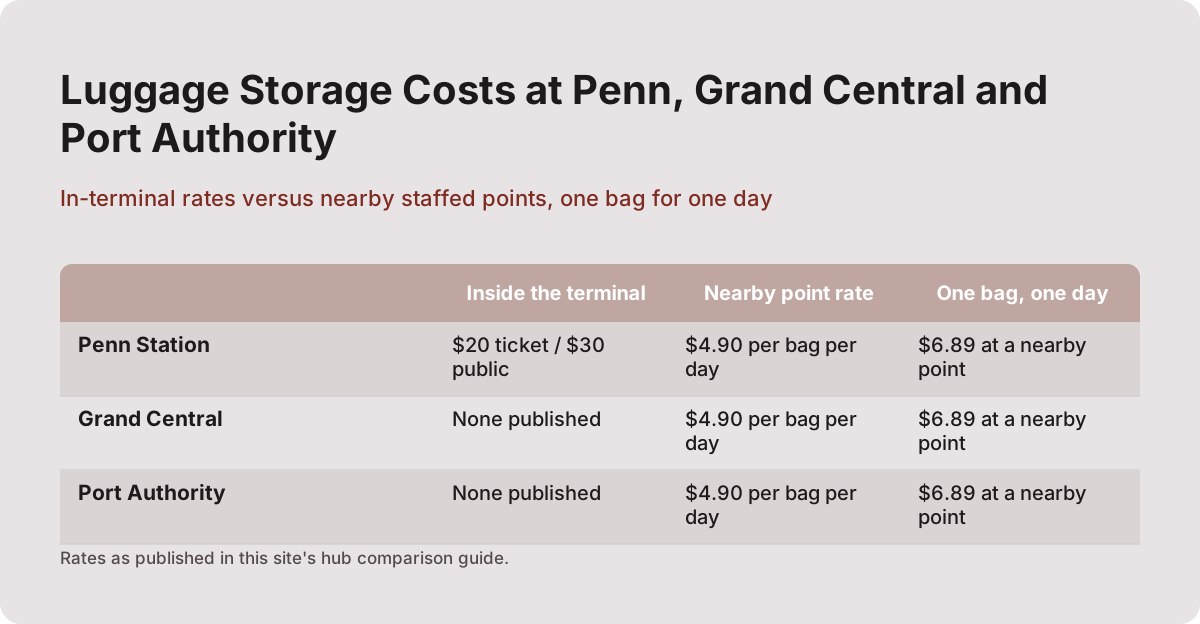
The in-station Amtrak counter at Penn charges $20 per item per 24 hours for ticketed customers and $30 for the general public, with the rate charged again at the start of each extra 24-hour period. Around all three hubs, bookable staffed points typically cost $4.90 per bag per day, plus a $1.99 per-bag fee added at checkout, so one bag for one day comes to $6.89 all in.
The two price structures are built for different trips. Amtrak's counter prices per item and per 24 hours, so a $30 general-public drop becomes $60 after two days and $90 after three. The surrounding points price per bag per day at a much lower typical rate, and the checkout fee is charged once per bag rather than per night: one bag for three days works out to $16.69. For a single overnight, the Amtrak counter wins on convenience and loses on price; for a multi-day hold, the arithmetic flips hard.
| Hub | Inside the terminal | Typical nearby point rate | All-in, one bag, one day |
|---|---|---|---|
| Penn Station | Amtrak counter, $20 with ticket / $30 public, per item per 24 hours | $4.90 per bag per day | $6.89 at a nearby point |
| Grand Central | None published | $4.90 per bag per day | $6.89 at a nearby point |
| Port Authority | None published | $4.90 per bag per day | $6.89 at a nearby point |
The advertised "from $2.90" string on the storage network's own New York page is worth treating carefully, because the operator itself now disclaims it: the page says that is "the lowest currently available city price, not a promise that every location or bag category has the same rate". This site's own measurement found 168 of 178 real New York point cards showing $4.90. Expect $4.90, treat $2.90 as marketing, and read the full price breakdown in what luggage storage costs in New York City.
A reader storing near Penn is usually weighing the Amtrak counter against a staffed point a block away, and the honest advice is to let the calendar decide. One item, one day, and the counter's $30 public rate is the price of not walking anywhere. Anything longer, or more than one bag, and the per-bag daily points pull ahead quickly. The electronics rule matters here too: the storage network's terms prohibit storing "Technological material (iPhone, iPad, Tablet, PC, smartphones)", while Amtrak publishes no such list for its counter. Anyone travelling with laptops should read what you cannot leave in a stored bag in New York before choosing either option.
How Far Is The Walk From Each Terminal To A Storage Point?
Penn Station has 27 bookable points within 800 metres of its anchor, Port Authority has 36 and Grand Central has 14, so the bus terminal actually has the densest ring of the three despite having nothing inside. Times Square, which sits between Port Authority and Penn, has 44 points, and a reader changing hubs can often book a point that is walkable from both ends of the connection.
The counts matter more than they look, because they are measured the same way for every hub: every point within 800 metres of that hub's geocoded anchor. They are also the only counts worth quoting. The storage network's own area pages are unreliable for this, because they list points anchored elsewhere in the city, so a single point can appear on many different pages. The counts here come from points within 800 metres of each area's own anchor. Judge a point by its address and its walking distance, not by which page shows it. Book by address, not by the number a page claims.
One practical wrinkle deserves a warning before it bites. A guest review pattern on the operator's Trustpilot page, where the company is rated 4.2 out of 5, includes a repeated complaint that the company "refuses to share even an approximate storage address until AFTER you've paid". A reader books an area and a price, and the specific shop address arrives with the confirmation. That is fine when the area is the size of Times Square and any address inside it works, and it is worth planning around when the reader needs a specific corner, say the 8th Avenue side of Penn for an early LIRR departure.
The geography of the three hubs makes the choice easier than it first appears. Penn and Port Authority are roughly a kilometre apart along the west side of Midtown, with Times Square in between, so a point near 42nd Street can serve a bus arrival and a train departure on the same booking. Grand Central sits on the east side, on the far side of the whole Midtown grid from the other two, so a reader changing between Grand Central and either west-side hub should book on the Grand Central side and travel light the rest of the way. The MTA's own rider guide tells travellers "don't travel with more than you can carry on your own, and avoid rush hour if you're transporting something big", which is the agency's own argument for dropping the bag before the change of line.
What Do The Hubs Themselves Publish About Lockers?
All three hubs publish zero lockers, and none of the 178 bookable points across the storage network's entire New York inventory is a self-service locker either: every one is a staffed counter. The only genuine public coin lockers this site has verified anywhere in New York are at the Statue of Liberty monument, and they hold a 25-cent deposit for two hours and cannot take a suitcase, because luggage cannot board the ferry at all.
The locker question is worth answering plainly because the domain name raises it. There is no locker bank at Penn, none at Grand Central, none at Port Authority, and no New York transport hub added one in 2025 or 2026 as far as any source opened in this site's research shows. Amtrak's own 2026 newsroom index carries no item about bag storage at all; its New York items are infrastructure, the East River Tunnel rehabilitation and a new train maintenance facility. Nothing changed about storing a bag at Penn this year, and the absence is still the story.

The rules that do exist are about behaviour, not storage. The Port Authority's binding terminal regulations prohibit abandonment outright: "No person shall abandon any property at the Terminal", and they cap what handlers will take, refusing any baggage "of such weight or size such that it cannot reasonably be carried by one person using a single handcart". The MTA's Rules of Conduct, by contrast, contain no unattended-property provision at all, a genuine difference between operators that most competing pages flatten into a false "the subway bans unattended bags". It does not.
| Hub | Lockers | Left-luggage counter | Nearest bookable alternative |
|---|---|---|---|
| Penn Station / Moynihan | None | Amtrak staffed counter, $20 or $30 per item per 24 hours | 27 points within 800 m |
| Grand Central | None, per the terminal's own FAQ | None | 14 points within 800 m |
| Port Authority Bus Terminal | None, per two official pages | None | 36 points within 800 m |
For readers who want the full locker picture across the city, including the tennis-centre permits and the parcel lockers on city sidewalks, the dedicated guide is which New York places have luggage lockers and which have none. The short version for this comparison: a reader changing hubs in New York is choosing between a staffed counter inside one station and a staffed counter in a shop beside the other two.
When Can You Drop Off And Pick Up Your Bag?
Penn's Amtrak counter sits inside Moynihan Train Hall, which publishes its own public hours as 5:00 AM to 1:00 AM daily, with Amtrak and LIRR services moving across 8th Avenue to the old Penn Station between 1:00 AM and 5:00 AM. The counter's own separate hours are unpublished, so a reader needing a bag back at 2 AM has no sourced answer from inside the station, and should plan around the surrounding points instead.
The Moynihan hours are the closest thing to a schedule anyone official publishes, and they come from the hall's own visitor page, which prints them twice. The same page carries the luggage sentence: storage is provided by Amtrak for all passengers, and readers should visit the Amtrak Customer Service desk to arrange it. Where that desk physically sits inside the complex, and what size or weight limit applies to a stored item, remain unpublished by anyone, and this site will not guess. Amtrak's station data does publish a checked-baggage window of 5:00 AM to 10:00 PM every day, but that is a different service, for bags travelling on trains.

The surrounding points are more forthcoming with hours than either hub is. Of the 27 points near Penn, 25 publish opening hours. At Port Authority, 34 of the 36 publish hours, and at Grand Central, 13 of the 14 do. Those hours vary by shop, and a reader with a late-night arrival should filter for the points that stay open, because a cafe that closes at 6 PM is not a place to leave a bag before a midnight bus. The dedicated guide on 24-hour and late-night luggage storage in NYC covers the overnight cases, and overnight and multi-day bag storage in NYC covers the longer holds.
One timing trap is specific to Penn. Moynihan Train Hall publishes its address as 421 8th Avenue and names the 31st Street midblock entrance between 8th and 9th Avenues as the passenger and taxi entry, but that is the entrance, not the storage counter's location, which no official page publishes. A reader walking to Moynihan for a bag drop should expect to ask at the Amtrak Customer Service desk rather than navigate to a published counter. Readers with more time than a connection allows can also weigh the hotel option, covered in detail in NYC hotel check-in and checkout times, though hotels hold bags for their own guests, and a non-guest has no entitlement anywhere.
Which Hub Should You Choose For Your Connection?
Choose Penn if the bag is one item for one day and you want zero walking, because the Amtrak counter is the only in-station option of the three. Choose Port Authority for the densest ring of nearby points, 36 within 800 metres, and Grand Central if the connection is east-side, since its 14 points are the thinnest spread of the three and worth booking early.
The comparison the target reader actually makes is not "which hub is best" but "which end of my connection gets the shorter walk". A bus arriving at Port Authority and a train leaving from Penn share the whole west side of Midtown, and the 44 points around Times Square sit between them. A Metro-North arrival at Grand Central and a departure from anywhere west means crossing Midtown once, and the bag should stay put on the east side until the crossing is done.

| Reader's situation | Best hub for the bag | Why |
|---|---|---|
| One bag, one day, train from Penn | Penn Station, Amtrak counter | No walk, $30 public rate, no booking needed |
| Bus in at Port Authority, train out at Penn | Times Square or Port Authority points | 36 to 44 points, walkable to both hubs |
| Metro-North at Grand Central, evening out | Grand Central points | 14 points, avoid crossing Midtown with the bag |
| Multi-day hold, any hub | Nearby staffed points | $16.69 for three days versus $90 at the Amtrak counter |
Ratings help break ties where counts do not. The points near Penn rate 4.84 across 3,583 reviews, the strongest pool of the three, though only 26 of the 27 points publish a rating at all. Port Authority's ring rates 4.79 across 2,126 reviews, Grand Central's 4.7 across 502. The pattern is consistent: the pools are large enough to trust at Penn and Port Authority, and thinner at Grand Central, where booking a point with published hours and a published rating matters more. Readers who want the full method can follow how to choose a luggage storage spot in New York.
The delay scenario deserves its own sentence. A reader whose bus or train runs late should check the point's hours before the scheduled pickup, because a staffed counter that closes before a delayed arrival means a bag sitting overnight in a closed shop. The guide on what happens if your train or flight is delayed covers the practical steps, and the guarantee that sits behind every booked bag, EUR 3,000 per bag under the operator's terms rather than the larger marketing figure, is unpacked in what the Radical Storage guarantee actually covers.
For a reader whose real question is simply where to put the bag for the afternoon, Luggage Storage Lockers in New York City keeps the whole measured inventory, 88 distinct points across 8 areas, each with its published hours and rating. The hub comparison above is the decision layer; the area pages are the booking layer, and the two work together: pick the hub end with the shorter walk, then pick the point on that street.
The Penn ring is the one this site rates highest of the three, 4.84 across 3,583 reviews, and it is the natural default for a reader who has not decided yet, because it serves Amtrak, LIRR and the subway at once. Book a point on the 8th Avenue side for a Moynihan departure, or the 7th Avenue side for the old Penn Station halls, and the walk is a couple of blocks either way.
Grand Central's ring is the thinnest, 14 east-side points against Port Authority's 36, and the east-side location means a reader changing to a west-side hub should not book here unless the whole itinerary is east. For a Metro-North day trip with an afternoon in Midtown East, it is the right side of the grid, and the terminal's own no-storage FAQ makes the nearby points the only option.
Times Square is the connector's choice, 44 points rated 4.79 across 2,400 reviews, sitting between Port Authority and Penn with more inventory than either. A reader changing between two of the three hubs can often book one point here and walk to both ends of the connection, which is the whole trick this comparison exists to teach.
Common Questions About Luggage Storage At New York's Train Stations
Can you store luggage at Penn Station, Grand Central or Port Authority?
Only Penn Station, via Amtrak's staffed counter: $20 per item per 24 hours with a ticket, $30 for the general public with photo ID. Grand Central and Port Authority both publish that they provide no baggage storage, so readers there use staffed points within 800 metres, typically $4.90 per bag per day plus a $1.99 checkout fee.
Are there lockers at any of the three hubs?
No. None of the three hubs publishes a locker bank, and none of the 178 bookable points in the storage network's New York inventory is a self-service locker; every one is a staffed counter. The only verified public coin lockers in the city are at the Statue of Liberty monument, and they cannot hold a suitcase.
Is the Amtrak counter at Penn cheaper than a nearby storage point?
For one item and one day, roughly comparable: $30 at the counter for the general public versus $6.89 all in at a nearby point. For multiple days the counter charges $30 again each 24 hours while a point charges $4.90 per day with the $1.99 fee charged once, so three days costs $16.69 at a point versus $90 at the counter.
Can I get my bag back late at night from Penn Station?
Moynihan Train Hall publishes public hours of 5:00 AM to 1:00 AM daily, and between 1:00 AM and 5:00 AM Amtrak and LIRR services move to Penn Station across 8th Avenue. The storage counter's own separate hours are unpublished by anyone official, so a 2 AM pickup has no sourced answer from inside the station. Of the 27 nearby points, 25 publish hours, and readers with late plans should filter for the ones that stay open.
Which hub has the most storage points nearby?
Port Authority, with 36 points within 800 metres of its anchor, against 27 at Penn and 14 at Grand Central. Times Square, between Port Authority and Penn, has 44, which makes it the best base for a reader changing between two of the three hubs.
Do I need a train ticket to use the Penn Station storage counter?
Amtrak's own page says no: temporary bag storage is available to the general public with valid photo ID, at $30 per item per 24 hours, while ticketed Amtrak customers pay $20. Moynihan Train Hall's page words it as "all passengers, regardless of the railroad operator", and the two official pages do not say exactly the same thing, so bring photo ID either way.