Storing Bags Before And After A New York Cruise
Disembarking at 8am with a full set of luggage and a flight that leaves at night is the longest paid storage window a New York traveller ever faces. Here is how to plan it.
Short answer
A cruise passenger off the ship at 8am with a night flight typically needs 12 to 14 hours of storage. Staffed bag drop points around Manhattan and Brooklyn run about $4.90 per bag per day plus a $1.99 checkout fee, and Amtrak's Penn Station counter charges $30 per item per 24 hours for the general public.
A cruise throws the classic New York luggage problem into its longest form. You step off the ship in the morning with a full set of bags, your cabin is gone, and your flight does not leave until the evening. That is a 12 to 14 hour storage window, sometimes longer, and it is exactly the window this site sells. The Manhattan Cruise Terminal sits on the west side of Midtown, and the Brooklyn Cruise Terminal sits in Red Hook, and each has a different set of storage points within reach.
The honest starting point is the one most cruise advice skips: New York has almost no public luggage lockers. Every storage point this site lists is a staffed counter at a shop, cafe or hotel desk. That is not a drawback for a cruise day, because a staffed counter takes a bag at 8am and hands it back at 6pm without you touching a coin slot. But it changes how you plan, because counters have opening hours and lockers, where they exist at all, do not take suitcases anyway.
Where Do Cruise Passengers Actually Store Bags In New York?
Most cruise passengers store bags at a staffed drop point near their terminal or near wherever they spend the day, not at the terminal itself. The Manhattan Cruise Terminal publishes no public left-luggage service, so the practical answer is one of the 16 Midtown storage points or the 44 Times Square points, both a short ride from the pier, at a typical $4.90 per bag per day plus a $1.99 checkout fee.
Neither cruise terminal operates a public bag storage counter of its own. That gap is the whole reason this site exists. What fills it is a network of staffed counters: this site publishes 88 distinct storage points across 8 areas of the city, every one of them a staffed counter rather than a locker, and each area page counts only the points within 800 metres of its anchor.
| Cruise terminal | Best-matching storage area | Points | Rating | Points publishing hours |
|---|---|---|---|---|
| Manhattan Cruise Terminal (west side of Midtown) | Midtown Manhattan | 16 | 4.7 across 596 reviews | 15 of 16 |
| Manhattan Cruise Terminal (west side of Midtown) | Times Square | 44 | 4.79 across 2,400 reviews | 42 of 44 |
| Brooklyn Cruise Terminal (Red Hook) | Brooklyn | 11 | 4.82 across 79 reviews | 11 of 11 |
For the Manhattan Cruise Terminal, the two areas that matter are Midtown Manhattan, with 16 points rated 4.7 across 596 reviews, and Times Square, with 44 points rated 4.79 across 2,400 reviews. For the Brooklyn Cruise Terminal in Red Hook, the Brooklyn area is the natural fit, with 11 points rated 4.82 across 79 reviews. The counts differ a lot, and that is real: the west side of Manhattan has the densest coverage in the city, while Red Hook has fewer counters and more of a walk or a short cab ride involved.
One planning note before the details. The storage network this site describes is the Radical Storage network, and Radical Storage itself now says on its New York page that "Prices start from $2.90 per bag. This is the lowest currently available city price, not a promise that every location or bag category has the same rate." The measured reality is that 168 of 178 New York point cards show $4.90, so $4.90 is the rate to plan around. More on the price arithmetic below.
How Does A Full-Day Bag Drop Work After You Disembark?
You book a point for the day, walk there from the terminal, hand the bags to staff at the counter, and collect them before the point closes. Booking fixes the area and the rate, and the exact street address is confirmed after payment, which is worth knowing before it surprises you. A typical cruise day costs $6.89 per bag all in: $4.90 for the day plus the $1.99 per-bag checkout fee.
The mechanics are simple, but the sequence catches people. You choose an area, say Times Square or Midtown, and book a bag for the day. The booking covers one bag for one calendar day at the listed rate, and the $1.99 fee is added per bag at checkout, once per bag rather than per night. On the day, you walk in, staff take the bag, and you get a collection time bound by that point's published hours. Most points publish their hours on their card, and the Times Square area has 42 of its 44 points publishing hours, which is the best coverage in the city.
One expectation to set before you pay. Radical Storage's model is that you book an area, not a specific shop, and a detailed complaint visible on its Trustpilot page in September 2026 says the company "refuses to share even an approximate storage address until AFTER you've paid." Treat that as guidance, not a dealbreaker: the booking flow does confirm the exact point before your cruise day, and knowing the address arrives after payment is simply how the system works. If you want a street address in your hand before money moves, the alternative is Amtrak's counter at Penn Station, covered below.
For a cruise day, the practical sequence looks like this. Off the ship at 8am, drop the bags by 9am, spend the day in the city, collect by late afternoon, then head to the airport. The one thing to check on your specific point card is the closing time, because a point that shuts at 6pm is fine for a 9pm flight from JFK and tight for a red-eye. The guide to 24-hour and late-night luggage storage in NYC covers the points that stay open latest if your flight leaves very late.
Between the drop and the collection, the city is yours, and this is where the cruise window beats every other storage scenario. A business traveller stores a bag for three hours. A cruise passenger stores it for a whole day, which means the point you choose should sit near what you actually want to do, not just near the pier. Midtown points put you within walking distance of the Theatre District and the west side piers. Times Square points put you at the centre of everything but in the busiest part of Manhattan. Brooklyn points pair naturally with a Red Hook or Dumbo day if your ship sails from Brooklyn and you want to stay on that side of the river.
What Does A Cruise-Day Storage Plan Cost?
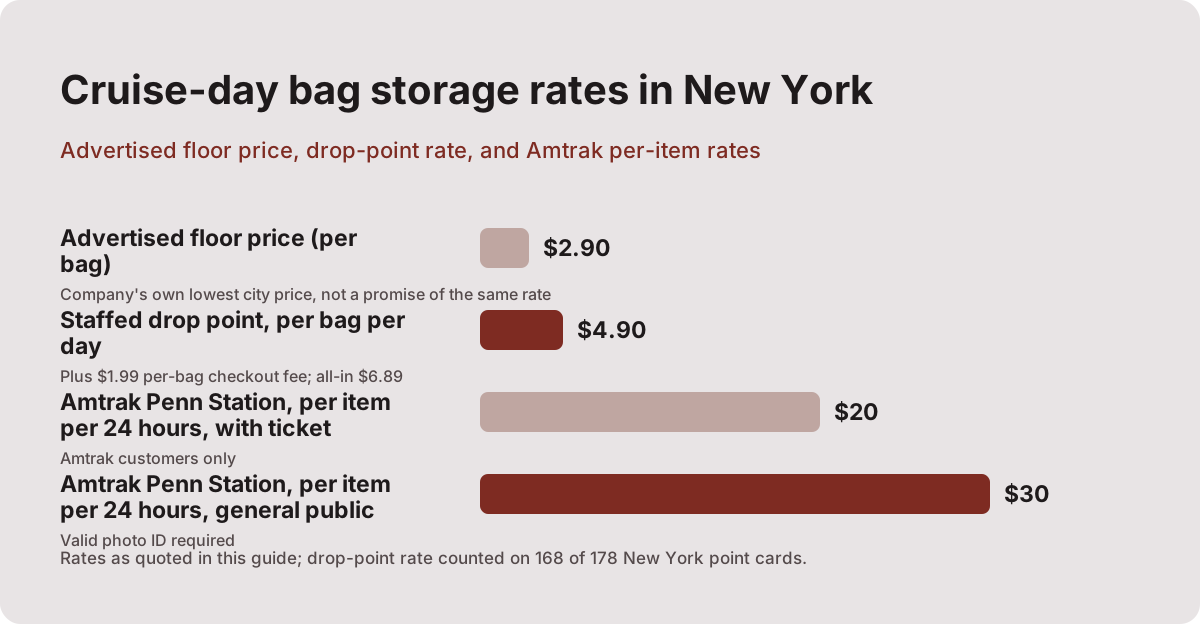
Plan on $6.89 per bag for one full day at a staffed drop point: the $4.90 day rate plus the $1.99 per-bag checkout fee. Amtrak's Penn Station counter is the fixed-price alternative at $30 per item per 24 hours for the general public, or $20 with a train ticket. A family with several bags still pays far less at a drop point than at Amtrak's per-item rate.
The price picture has two honest layers. The advertised "from $2.90" is Radical Storage's own floor price, and the company itself now disclaims it as "the lowest currently available city price, not a promise that every location or bag category has the same rate." The measured New York rate, counted on 168 of 178 point cards, is $4.90. Add the $1.99 per-bag checkout fee, which appears every single time a price is quoted, and one bag for one day is $6.89. The full price including that fee is displayed before you pay, so there is no surprise at checkout, only arithmetic you can do in advance.
| Option | Rate | What it covers | Requirement |
|---|---|---|---|
| Staffed drop point (any area) | $4.90 per bag per day, plus $1.99 per bag | One bag, one calendar day | Booking in advance; hours vary by point |
| Amtrak bag storage, Penn Station | $30 per item per 24 hours | General public | Valid photo ID |
| Amtrak bag storage, Penn Station | $20 per item per 24 hours | Amtrak customers | Valid ticket |
| JFK Terminal 4 storage | Not published | Up to 72 hours | Confirmed ticket, photo ID, boarding pass |
| Hotel bell desk (example) | $5.00 per bag after two free | Guests only, day of departure | Being a guest of that hotel |
The Amtrak line deserves its own paragraph because it is the most contradicted fact in this niche. Most travel content says New York stations have nothing. In fact, Amtrak publishes temporary bag storage at staffed stations, available "to both Amtrak customers (valid ticket required) and the general public (valid photo ID required)," at $20 and $30 per item per 24-hour period respectively, with the rate charged again at the start of each additional 24 hours, per Amtrak's own baggage services page. For a cruise passenger with two heavy bags and no train ticket, the Amtrak counter costs two full per-item rates for the day, while the same two bags at a drop point cost roughly twice the single-bag price. The drop point wins on price; the Amtrak counter wins on being a single fixed location with a published rate.
The hotel line is the one people reach for first and it needs honesty. Broadway Plaza Hotel publishes the most complete policy found anywhere: "We store luggage before check in and on the day of departure only. We cannot store overnight. Each guest is able to store up to two bags on a complimentary basis. Any additional will cost $5.00 per bag." The New Yorker, a Wyndham hotel, publishes "Luggage storage is available for a fee of $5 per bag for Registered Guests only." Those are guest services. No New York hotel publishes any policy on holding bags for people who are not staying there, so if your cruise package included a pre-cruise hotel night, ask that hotel directly, and expect the answer to be before-check-in and day-of-departure only. The guide to what luggage storage costs in New York City breaks the full price picture down.
Can You Store Bags Overnight Or For Several Cruise Days?
Yes, and the arithmetic matters. Drop points charge the day rate per calendar day, with the $1.99 fee charged once per bag rather than per night, so one bag for three days is $16.69 all in. Amtrak charges its full 24-hour rate again at the start of each additional period, so the same bag costs three full per-item rates at the public price.

Let me state the multi-day arithmetic cleanly, because the fee structure is not obvious. The $1.99 checkout fee is charged once per bag, not per night. One bag for three days is therefore three day rates plus one fee, which comes to $16.69 all in. Two bags for the same three days simply doubles the day-rate side of that sum and adds a second fee, so the per-bag cost keeps falling as the stay lengthens. That is the number to compare against Amtrak, where the same one bag for three days at the public rate means paying the full per-item price three times over, because the rate is "charged at the beginning of each additional 24-hour period."
The calendar-day detail is the one that bites. A drop point day rate is per day, so a bag dropped at 9am Monday and collected 9pm Tuesday is two days, not one. For a classic cruise passenger this rarely matters, because the window is one long day. It matters for the passenger doing a back-to-back, or the one whose flight is cancelled and who needs the bag until Thursday. The guide to overnight and multi-day bag storage in NYC covers which points suit multi-day holds and what to check before committing.
There is one more overnight wrinkle worth a line. Moynihan Train Hall, the Amtrak side of Penn Station, publishes its own hours as 5:00AM to 1:00AM daily, and during the overnight gap Amtrak and LIRR services move across the avenue to the older Penn Station halls. If you store with Amtrak and your flight leaves at 6am, you cannot collect from the Train Hall at 4am, because the hall itself is shut. Amtrak publishes no separate hours for the storage counter, so plan a collection inside the hall's published window and do not assume a 24-hour desk.
What Are The Options Near The Brooklyn Cruise Terminal?
Red Hook has no dense cluster of storage counters, so the practical answer is the Brooklyn area's 11 points, rated 4.82 across 79 reviews, all 11 publishing hours, at the usual $4.90 per bag per day plus the $1.99 fee. The Brooklyn Cruise Terminal sits in an industrial corner of the waterfront, and the nearest points sit closer to the neighbourhoods you would actually visit, so budget a short cab ride with the bags.
The Brooklyn points are the quietest area this site publishes, 11 of them, and that small pool is also the most consistent: all 11 publish their hours, and 8 of them publish a rating. The area rates 4.82 across 79 reviews, which is a small review pool and should be read as exactly that, a small pool of mostly positive reviews rather than a city-wide verdict. What the area gives you is a day in Brooklyn without dragging suitcases over the cobblestones of Dumbo or through the Red Hook warehouses.
The honest trade-off is location. The Manhattan terminal has Midtown and Times Square points within a short ride of the pier. Red Hook is further from its area's points than any other terminal pairing on this site, so the decision is really about where your day happens. If your plan is the Brooklyn Bridge, Dumbo and a long lunch, drop the bags in Brooklyn and stay on that side of the river. If your plan is Broadway or the museums, take the bags to Manhattan on arrival and store them there, because crossing back over the East River twice with luggage is the worst of both worlds.
For a Brooklyn-sailing cruise, the sequence that works is: off the ship, cab with the bags to your chosen point, drop, spend the day, collect, and head straight to the airport from Brooklyn rather than backtracking through Manhattan. JFK is reachable from Brooklyn without crossing the city, and the AirTrain connection from Jamaica or Howard Beach costs $8.75 one way, a fare the airport publishes itself, per the JFK AirTrain page. That page also carries a standing advisory worth quoting: "Getting to and from JFK may take longer than usual due to construction at the airport. Please allow for significantly more time." Build that slack into your collection time.
Should You Store At Penn Station Or The Airport Instead?
Penn Station works as a single fixed drop for a Manhattan day, at $30 per item per 24 hours with photo ID, and it is the only left-luggage counter inside a Manhattan transport hub. The airports do not work as a cruise-day base: JFK's Terminal 4 storage requires a confirmed ticket and boarding pass, publishes no price, and sits an hour from the piers, while LaGuardia and Newark list no baggage storage at all.

Penn Station's counter is the option most content denies exists. Amtrak's station data for New York Penn carries the flag "Bag storage (with Fee)," and Moynihan Train Hall's own page says "Luggage storage is provided by Amtrak for all passengers, regardless of the railroad operator that you're traveling with. Please visit the Amtrak Customer Service desk to arrange luggage storage." Handle the eligibility honestly: Amtrak's sitewide page says the general public may use it with photo ID, Moynihan's page says all passengers, and those two official sources do not say the same thing. Quote both, as this article does, and bring photo ID either way.
The airport route deserves a warning rather than a recommendation. JFK does have real storage, operated by Smarte Carte at Terminal 1 and Terminal 4, and Terminal 4's counter is open 24 hours a day, but the operator's terms are strict: "Photo ID and Boarding Pass Required," "All Bags Must Be Locked," and full payment on drop-off, per Smarte Carte's JFK page. No price is published anywhere, and the honest instruction is to call the operator at 718-916-8963 and ask, not to guess. For a cruise passenger whose flight leaves JFK that night, the geometry is wrong anyway: you would ride an hour to the airport, store, ride an hour back to the city, then ride out again. Store in Manhattan or Brooklyn and go to the airport once.
For the Manhattan-sailing majority, the Midtown points are the natural fit: 16 points rated 4.7 across 596 reviews, 15 of them publishing hours, all within reach of the west side piers and of Penn Station if you want the Amtrak counter as a backup plan. The comparison guide to Penn Station versus Grand Central versus Port Authority is useful here, because it records what the other two hubs publish: Grand Central answers the storage question with a flat no, and the Port Authority Bus Terminal says it does not provide baggage storage facilities. Penn is the only hub counter in the mix.
What Can You Not Leave In A Stored Bag?
Electronics are the big exclusion. The storage network's terms prohibit storing "Technological material (iPhone, iPad, Tablet, PC, smartphones)" at all, and a prohibited item voids the entire coverage claim if something goes missing. The guarantee per bag is EUR 3,000 under the terms, whatever the marketing pages say, and it is not insurance.
This is the section that saves people real money, and almost no competing page covers it. The terms and conditions that bind a booking state: "Each Bag is covered with a Radical Storage Guarantee for a value of EUR 3000" and "the Company will pay up to a maximum of EUR3000 per claim." The marketing pages advertise a 10,000 figure, printed as "EUR 10,000" in one place and "$10,000" in another on the very same New York page, and that number appears nowhere in the terms. This site reports the terms figure. The guarantee is also not insurance, the terms say so themselves, and claims carry a one-week deadline with a 48-hour window to file a police report.
The electronics rule deserves its own planning note. Cruise passengers carry phones, tablets and sometimes laptops, and the terms exclude all of them from storage. The practical move is to keep electronics in a small day bag that stays with you, and store the big suitcases with clothes and toiletries. That split costs nothing, keeps the claim valid, and matches how most points operate anyway, since a staffed counter takes your sealed bag and does not want your devices any more than the terms do.
| Item | Can it go in a stored bag? | Why |
|---|---|---|
| Clothes and shoes | Yes | Standard stored items |
| Toiletries (non-flammable) | Yes | Standard stored items |
| Phones, tablets, laptops | No | Prohibited items clause; voids any claim |
| Cruise documents and passport | Keep with you | ID is needed to collect the bag |
| Flammable materials | No | Prohibited under the terms |
The guide to what you cannot leave in a stored bag in New York lists the full prohibited set. For the cruise day specifically, the short version is: clothes in the case, devices and documents on your body, and nothing you would be lost without if the claim process ran its full course.
How Early Should You Collect Bags Before A Night Flight?
Collect at least three hours before a domestic departure and four before an international one, then add the airport's own travel warning on top. JFK publishes a standing construction advisory telling travellers to allow significantly more time, and the AirTrain fare is $8.75 one way from Jamaica or Howard Beach, so the collection time at your storage point must work backwards from all of it. A 6pm collection comfortably makes a 9pm international flight.
The arithmetic runs backwards from the gate. Take a 9pm international flight from JFK. You want to be at the airport by 6pm, which means leaving Manhattan or Brooklyn by 4:30pm at the latest, which means collecting the bags by 4pm. Work back further and your storage point must be open past 4pm, which almost all are, but check the card: the Times Square area has 42 of 44 points publishing hours, Midtown 15 of 16, Brooklyn all 11, and the hours are on the card precisely so you can do this sum before you book.
Two closing cautions from the official record. First, the MTA's own rider guide tells travellers: "Don't travel with more than you can carry on your own, and avoid rush hour if you're transporting something big." That is the agency's advice, not this site's, and it is aimed exactly at a cruise passenger dragging two suitcases onto a 5pm train. Second, the LIRR's current City Terminal timetable states "Luggage may not be left unattended" and that bags are subject to random search, which is why a paid, staffed counter exists in the first place. Store the bags, travel light, and the last day of your cruise becomes a normal New York day.
The full picture, in brief: pick your area by where you will spend the day, not by the pier. Book in advance so the rate and the point are locked. Keep devices and documents with you. Check the closing hours against your flight, work the collection time backwards from the gate, and add slack for airport construction if you are flying from JFK. For a deeper look at the whole locker question, see Luggage Storage Lockers in New York City, and for the wider question of which venues will even take a suitcase, the guide to how to choose a luggage storage spot in New York walks the decision step by step.
Common Questions About Storing Bags Before And After A New York Cruise
Where do cruise passengers actually store bags in New York?
At a staffed drop point near the terminal or near wherever they spend the day. Neither cruise terminal operates public storage, so the practical answer is one of the 16 Midtown points or 44 Times Square points for Manhattan sailings, or the 11 Brooklyn points for Red Hook, at a typical $4.90 per bag per day plus the $1.99 checkout fee.
What does a full cruise day of storage cost?
One bag for one day is $6.89 all in at a staffed drop point: the $4.90 day rate plus the $1.99 per-bag checkout fee. Amtrak's Penn Station counter charges $30 per item per 24 hours for the general public with photo ID, or $20 with a train ticket.
Can I leave bags overnight between cruise days?
Yes. Drop points charge the day rate per calendar day with the $1.99 fee charged once per bag, so one bag for three days is $16.69 all in. Amtrak charges its full 24-hour rate at the start of each additional period, so the same bag at the public rate means paying the per-item price three times over.
Can my hotel hold the bags on cruise day instead?
Only if you are a guest, and only around check-in and checkout. Broadway Plaza Hotel stores luggage before check-in and on the day of departure only, two bags free then $5.00 per bag, and The New Yorker charges $5 per bag for registered guests only. No New York hotel publishes a policy for non-guests.
Can I store bags at the airport on cruise day?
It is usually the wrong geometry. JFK Terminal 4 has 24-hour storage but requires a confirmed ticket and boarding pass, publishes no price, and sits about an hour from the piers. LaGuardia and Newark list no baggage storage in their own services at all. Store in Manhattan or Brooklyn and go to the airport once.
What can I not leave in a stored bag?
Electronics. The terms prohibit storing technological material including phones, tablets and laptops, and a prohibited item voids the entire claim. The guarantee is EUR 3,000 per bag under the terms, it is not insurance, and claims carry a one-week deadline with a 48-hour police-report window.